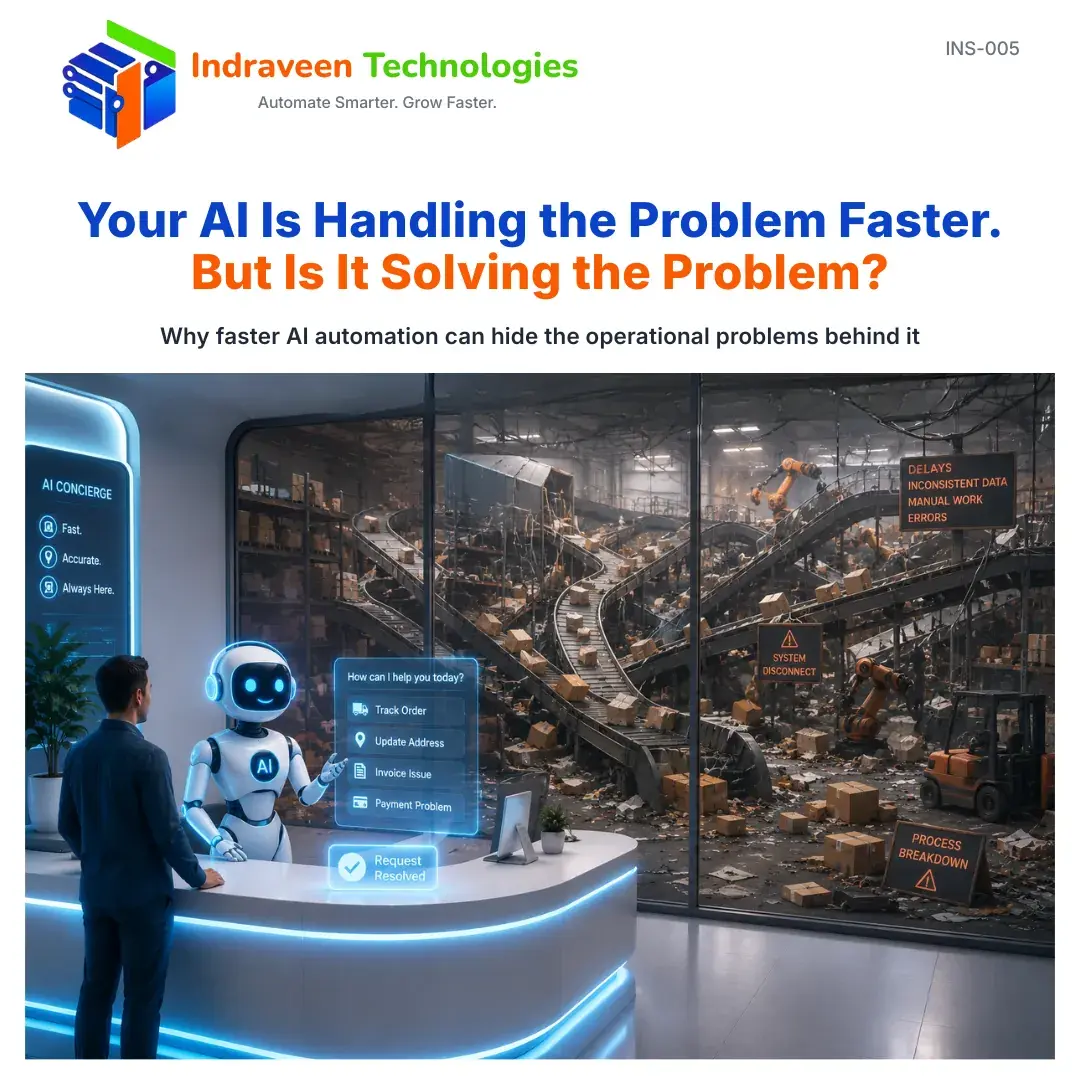
1. The Bot Is Doing Its Job. So Why Is the Problem Still There?
Imagine a customer contacting a company because an order has not arrived. The company's AI assistant handles the request immediately. It checks the order status, explains the delay, provides the customer with the latest information, and closes the interaction.
The customer gets an answer without waiting for an employee. The company records another successful AI interaction. The response time has improved, the employee workload has decreased, and the cost of handling the request has fallen. From an automation perspective, everything appears to be working exactly as intended.
Now imagine that the same company is still receiving thousands of similar requests every month. The AI continues to answer them successfully, response times continue to improve, and the automation rate looks impressive on the management dashboard. But the underlying delivery problem has not changed. Customers are still waiting, and they are still asking where their orders are.
The AI has become very good at handling the consequence of the problem, but it has not necessarily helped the business understand why the problem keeps occurring. That distinction is easy to miss when automation is evaluated primarily through productivity metrics.
Faster handling is still a real improvement
There is an important point to make before going any further: there is nothing inherently wrong with this kind of automation. If an AI system can answer a customer question in seconds instead of requiring an employee to spend several minutes finding the same information, that is a genuine operational improvement.
The business saves time, employees can focus on work requiring human judgment, customers receive faster responses, and the organization reduces its cost per interaction. These are meaningful benefits that businesses should absolutely pursue where the economics make sense.
The problem begins when the organization assumes that making the response more efficient means the underlying process has also become better. Those are two different outcomes. A business can become extremely efficient at processing a problem that it has never actually solved.
Consider a different example: an employee receives ten requests every day because a particular report contains incorrect information. An AI system is introduced to identify the error, correct the report, and send the updated version. The ten requests are now handled automatically, and the automation has worked. But if the same incorrect information continues to be generated every day, the organization has not eliminated the source of the work; it has simply built a more efficient mechanism for dealing with its consequences.
Key Operational Question
When evaluating technology investments, organizations often ask: "How much work did we automate?" A more powerful question is: "Why did this work exist in the first place?"
The difference between handling work and improving the system
At one level, automation is about execution. A person performs a task repeatedly, the organization identifies that task, and technology performs some or all of it automatically to achieve faster execution, lower effort, or lower cost.
At another level, however, automation can become a source of operational information. The system can reveal what customers repeatedly ask for, where exceptions occur, which requests require human intervention, which transactions fail, where delays happen, and which problems keep returning.
- Efficiency-First Approach: Asks "How can we handle this work more efficiently?"
- Intelligence-First Approach: Asks "What is the work telling us about how the business operates?"
In the first scenario, success may mean that the AI resolved 80% of incoming requests. In the second, that 80% is only the beginning of a deeper operational inquiry. Management begins asking what the remaining 20% are, why they need humans, and if the process can be changed so fewer requests are created at all.
2. Automation Can Improve a Process Without Improving the Process
It is tempting to treat automation as a binary outcome: a task was manual, AI was introduced, the task is now automated, and therefore the process has improved. In practice, the relationship is not that simple. Automation can produce a very real improvement at the task level while leaving the broader workflow almost completely unchanged.
Consider a customer-support operation where an employee previously spent several minutes reading a customer's message, locating information, checking order status, and composing a response. An AI assistant performs much of that work in seconds, reducing effort and accelerating customer service. Yet, the automation has not necessarily changed why the customer had to contact the company in the first place.
A business process is rarely a single task. A customer support interaction sits at the end of a much longer chain:
Order placed → inventory processed → shipment prepared → carrier assigned → delivery attempted → customer informed
If something goes wrong anywhere in that chain, the customer may eventually contact support. Automating the support response changes the final step without automatically changing the preceding workflow.
From task automation to workflow redesign
Enterprise research highlights this distinction. McKinsey's 2025 State of AI research found that while nearly nine out of ten surveyed organizations report regular AI use, most struggle to move from experimentation to scaled enterprise-level value. The research identified workflow redesign as one of the strongest factors associated with meaningful business impact. Among AI high performers, 55% said their organizations had fundamentally redesigned workflows, compared with 20% of other respondents—a difference of 2.8 times. [1]
This shifts the fundamental question from "Where can we put AI?" to "How should the work itself change because AI is now available?".
For example, a basic AI implementation might just extract invoice details automatically to save time. A more ambitious implementation examines the entire accounts-payable workflow—from receipt to payment—asking why invoices fail matching or why approvals take days.
Three different questions
This framework gives organizations three progressively deeper questions to ask:
- Can we automate this task? This starting point focuses on reducing manual effort, processing time, and transaction cost.
- Can we improve the workflow around this task? Here, the organization looks at connected steps to reduce handoffs, rework, and bottlenecks.
- What is the work itself telling us about the business? The organization begins looking at recurring requests, failed transactions, and delays to understand why the workload exists, creating a feedback loop between automation and process improvement.
3. The Faster Front Door
The idea that inspired this article can be summarized in one uncomfortable question:
What if your AI isn't reducing your problems — it's simply becoming better at handling them?
Imagine a customer whose package is delayed. They open a chat window, and an AI assistant immediately responds. It checks the tracking information, explains the delay, apologises for the inconvenience and closes the conversation.
From the customer's perspective, the experience is smoother than waiting in a phone queue. From the company's perspective, another ticket has been resolved automatically.
Now imagine the same conversation happening thousands of times every month.
The chatbot is performing exactly as designed. The delivery process is not.
The organisation has become highly efficient at responding to the consequence of the problem while learning very little about why the problem keeps occurring.
This is the faster front door. The customer interaction has become faster, but the house behind it hasn't necessarily changed.
The Concept That Explains This: Failure Demand
Long before generative AI entered boardroom conversations, British occupational psychologist and systems thinker John Seddon developed the concept of Failure Demand while studying service organisations and call-centre operations.
Failure Demand describes demand created because something was not done, or was not done correctly, in the first place. It contrasts with Value Demand — the legitimate reason a customer contacts an organisation. [3]
The distinction is simple:
| Value Demand | Failure Demand |
|---|---|
| "I'd like to place an order." | "Where is the order I already placed?" |
| "I'd like to open an account." | "Why wasn't my account activated?" |
| "I'd like technical support." | "The previous fix didn't work." |
| "I'd like to renew my policy." | "I never received the renewal confirmation." |
Value demand creates business. Failure demand creates avoidable work.
And failure demand usually doesn't originate in the contact centre. The support team simply becomes the place where an earlier process failure becomes visible.
The "Where Is My Order?" Problem
Consider two organisations facing the same delivery problem.
Company A: A shipment is delayed. The customer receives no proactive communication, contacts support, and the AI assistant responds instantly and resolves the ticket. The dashboard records another successful automated interaction.
Company B: A shipment is delayed. The logistics system detects the delay, the customer is informed proactively, and the recurring cause of the delay is investigated. The logistics workflow is improved, and future deliveries become more reliable.
Both companies used technology.
Only one reduced the likelihood of the customer needing to contact support again.
The difference isn't the chatbot. It is what happened after the organisation had evidence that a problem existed.
When Efficiency Hides the Real Issue
This is where automation can become misleading.
An organisation may see its AI resolution rate increase dramatically:
| Month | Tickets Received | AI Resolution Rate |
|---|---|---|
| January | 12,000 | 20% |
| February | 12,100 | 45% |
| March | 11,950 | 70% |
The numbers look excellent. But suppose delivery delays and repeat customer contacts remain high throughout the same period.
The organisation has become better at processing the consequences of the delivery problem without reducing the problem itself.
The automation metric improved. The underlying business outcome did not.
The Faster Front Door
Automation can make an organisation extremely efficient at handling a problem without making the problem itself less likely to occur.
This is why recurring demand should not always be treated simply as workload. It can also be diagnostic information.
A repeated customer request may point to a product problem. A repeated invoice correction may point to a data problem. A repeated delivery enquiry may point to a logistics problem. A repeated escalation may point to a workflow or policy problem.
The automation system is therefore doing more than answering questions or processing transactions. It is collecting evidence about how the business operates.
The important question is whether the organisation is using that evidence merely to make the front door faster — or to understand what is happening behind it.
The real opportunity is not just to resolve the problem faster. It is to learn why the problem keeps arriving at the door.
4. What the Automation Is Telling You
Once an organisation starts automating a process, something interesting happens: the system begins producing information about the work at a scale that can be difficult for people to observe manually.
A customer asks a question. A request is classified. An order moves from one stage to another. A payment fails validation. A case is escalated. An employee intervenes. A transaction is completed.
Individually, these events may appear insignificant. Collectively, they can reveal how the business actually operates.
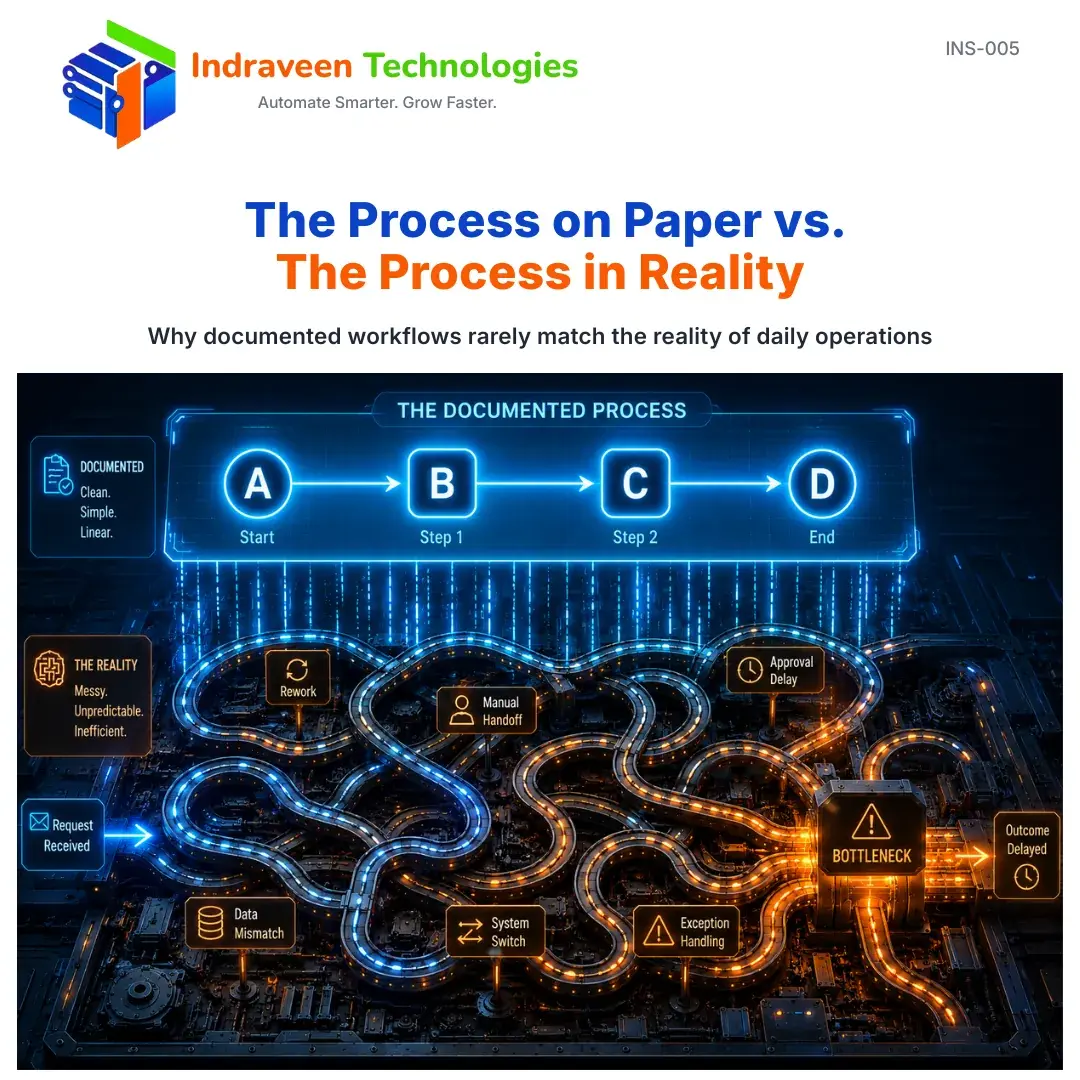
That matters because the process an organisation believes it follows and the process that actually happens are not always the same.
The Process on Paper Is Not Always the Process in Reality
Most businesses have documented procedures. An order is supposed to follow a defined sequence, a support request is supposed to move through specific stages, and an invoice is supposed to be matched, approved and paid.
But real operations rarely follow the diagram perfectly.
People bypass steps. Approvals happen in a different order. Information is corrected manually. Exceptions create additional work. Some requests are sent backwards through the process. Over time, these deviations can become part of the way the business actually operates.
This is one of the problems that process mining is designed to address. [4][5]
Process mining analyses the event data generated by information systems to reconstruct and analyse how processes are actually executed. Established applications include process discovery, which derives a process model from event data, and conformance checking, which compares observed behaviour with an expected process to identify deviations.
The basic idea is straightforward:
Instead of asking only how employees say the process works, examine the evidence left behind by the process itself.
From Transactions to Event Data
Consider a simple order. An organisation might record events such as:
Order created → Payment received → Inventory checked → Order approved → Shipment prepared → Shipment dispatched → Delivery completed
Each of these is an event.
When thousands of such events are recorded, they can be grouped into individual process instances and analysed as sequences of activity. Together, these records form what is commonly called an event log. [4][5]
Event logs can come from ERP systems, CRM platforms, workflow applications and other business systems. The value comes from looking at the events together rather than treating every transaction as an isolated record.
Suppose a company believes that its order-to-delivery process normally follows a straightforward sequence. The data might reveal that a significant percentage of orders actually follow a very different path:
Order → Payment → Manual verification → Exception queue → Sales intervention → Inventory correction → Approval → Shipment
The documented process may never have shown those additional steps.
The data does.
That can completely change the conversation.
Automation Creates More Than Efficiency
This is where AI automation and process intelligence begin to intersect.
An automated system does not just perform work. It can also create a detailed record of what happened while that work was being performed.
For example, an AI support system might record:
- the customer's original request;
- the category assigned to it;
- the information retrieved;
- whether the AI resolved the request;
- whether a human intervened;
- why the case was escalated;
- how long resolution took;
- whether the customer returned with another request.
Now consider what happens when those records are analysed across thousands of interactions.
The organisation may discover that apparently different questions are actually variations of the same underlying issue. It may discover that certain requests are disproportionately likely to require human intervention, that a particular workflow stage repeatedly causes delays, or that one category of customer request is growing even though the overall number of tickets appears stable.
The automation has therefore created something more valuable than a collection of completed tasks.
It has created operational evidence.
From Operational Evidence to Process Intelligence
Process mining is not simply about producing diagrams of business processes. It can help organisations discover how processes actually behave, identify deviations from expected workflows and analyse where performance problems occur.
This creates a progression:
What happened?
The event data shows the actual sequence of activities.
↓
Where does the process differ from what we expected?
Conformance analysis identifies deviations.
↓
Where are the delays, loops or exceptions?
Performance analysis identifies problematic areas.
↓
What characteristics are associated with those outcomes?
Additional process and business data can be examined.
↓
What might be causing the problem?
Root-cause investigation can then examine plausible explanations.
That final step is important because finding a pattern is not the same as proving its cause.
Data Can Show the Pattern. People Still Need to Understand It.
Suppose an organisation discovers that orders requiring manual approval take three times longer to complete.
That is a useful finding, but it does not automatically tell us why.
Perhaps the approval rule is unnecessarily strict. Perhaps employees do not have enough information to approve the order. Perhaps the required information exists in another system. Perhaps the approval is necessary because certain orders genuinely carry additional risk. Or perhaps the workflow was designed years ago and nobody remembers why the step exists.
The data can identify the pattern.
The business still needs to investigate the meaning behind it.
This distinction matters when AI enters the picture. AI can help classify large volumes of interactions, identify patterns, summarise exceptions and surface relationships that would be difficult to examine manually.
But the objective should not be to replace business judgement with another automated conclusion.
The objective is to give people better evidence with which to make better decisions.
The Feedback Loop Begins Here
This creates the missing connection between automation and process improvement.
The sequence can look like this:
Work happens
↓
Automation handles the work
↓
Events and outcomes are recorded
↓
Patterns and exceptions become visible
↓
The organisation investigates what they mean
↓
The underlying process is improved
↓
The automation is adjusted
↓
The new outcome is measured
↓
The cycle begins again
The important part is the loop.
Automation is not treated as a project that ends when the software goes live. The operation becomes something that can be observed, measured and progressively improved.
And once automation becomes a source of operational evidence, the question changes.
It is no longer simply:
"How many tickets did our AI resolve?"
It becomes:
"What is our AI telling us about the way the business operates?"
5. Closing the Loop: From Automation to Continuous Improvement
Knowing that a problem exists is not the same as knowing what to do about it.
An organisation may discover that a particular type of customer request occurs thousands of times every month. It may identify the workflow stage where most delays occur, or know which transactions are most likely to require human intervention.
The next question is more difficult:
What should change?
This is where automation needs to become part of a continuous improvement loop rather than a one-time technology deployment.
The Automation Should Not Be the End of the Process
A common pattern in technology projects looks like this:
Identify a repetitive task → Build or deploy automation → Measure the efficiency gain → Declare success
A more mature approach adds several steps:
Identify the process → Automate the appropriate work → Observe what happens → Capture exceptions and outcomes → Identify recurring patterns → Investigate the underlying causes → Improve the process → Update the automation → Measure the new outcome
The difference is important.
In the first model, automation is the destination.
In the second, automation becomes part of a feedback loop. The system performs useful work, produces evidence about what happened, and that evidence is then used to improve the next version of the process.
Exceptions Are Not Just Failures
Consider an AI system that successfully handles 85% of customer requests and sends the remaining 15% to employees.
A conventional automation dashboard might treat that 15% simply as the portion that the AI could not handle. That is useful information, but it is incomplete.
Those exceptions may contain some of the most valuable information in the entire system. Perhaps most come from one particular type of request. Perhaps the AI cannot access information held in another system. Perhaps a business rule is unclear, employees are routinely making the same correction, or the exception is evidence that the underlying process itself is poorly defined.
The important question therefore isn't simply:
"How do we increase automation from 85% to 95%?"
It may instead be:
"Why do these 15% of cases behave differently?"
Sometimes the answer will be that the AI needs improvement. Sometimes the workflow needs improvement. And sometimes the exception is legitimate and should remain under human control.
The objective is not to eliminate every exception simply to improve an automation percentage.
It is to understand what those exceptions are telling the business.
Every Exception Can Become a Question
This way of thinking changes how an organisation looks at operational data.
Instead of treating an exception as an isolated failure, ask why it happened. Instead of treating a repeated customer request as another ticket, ask why the request keeps occurring. Instead of treating a long process cycle as an unfortunate statistic, ask where the time is being lost. And instead of treating manual intervention as unavoidable overhead, ask what causes people to intervene.
The answers may lead in very different directions.
A process may need better data. A business rule may need clarification. Two systems may need to communicate with each other. An approval step may no longer be necessary. Employees may be working around a limitation in the software. Or the process itself may have been designed around assumptions that are no longer true.
Automation cannot answer all of these questions by itself. But it can make the evidence available at a scale that would be difficult to achieve through manual observation.
Process Improvement Is Not Always an AI Problem
Once a recurring problem has been identified, the solution does not necessarily need to involve more AI.
The best solution might be:
- removing an unnecessary process step;
- changing a business rule;
- improving a form;
- integrating two existing systems;
- correcting a master-data problem;
- changing an approval policy;
- improving customer communication;
- fixing a software defect;
- redesigning a workflow.
In some cases, the correct solution may be a simple deterministic automation. In others, it may require custom software. AI may be involved somewhere in the workflow, or it may not be necessary at all.
The purpose of operational intelligence is not to create more opportunities to deploy AI.
It is to make better decisions about how the business should operate.
Closing the Loop
Consider the delivery example from earlier.
A customer asks about a delayed shipment. The AI identifies the request and provides the available information. The interaction is recorded and categorised. After thousands of similar interactions, a pattern becomes visible.
The organisation investigates the logistics workflow and discovers a recurring cause of the delays. The workflow is changed, customer communication is updated, and the automation is adjusted to reflect the new process.
Future delivery-related requests are then measured to determine whether the underlying problem has actually decreased.
The complete loop now looks like this:
Customer problem
↓
AI handles the interaction
↓
Operational data is captured
↓
Recurring pattern becomes visible
↓
Underlying process is investigated
↓
Process is improved
↓
Automation is updated
↓
Business outcome is measured
↓
The cycle begins again
This is the important shift.
Automation is no longer treated as a project that ends when the software goes live. The operation becomes something that can be observed, measured and progressively improved.
The Real Objective Is Not More Automation
A business should not measure the success of automation only by asking:
"How much work did the system take away from people?"
That is an important question. But there is another one:
"What did the automation teach us about the work that remained?"
And then another:
"What did we change because of what we learned?"
If the answer to the final question is always "nothing", the organisation may be automating efficiently without learning operationally.
The more mature model is different:
Automation performs the work.
Data records what happened.
Analysis identifies patterns.
People investigate what those patterns mean.
The business changes the process.
Automation evolves with it.
And once that loop exists, AI automation stops being merely a way to process today's workload faster.
It becomes part of how the organisation discovers what tomorrow's process should look like.
6. Stop Measuring Only What the Bot Did
Once an automation system is running, measurement becomes unavoidable. The organisation needs to know whether the investment is producing value.
How many interactions did the AI handle? How much time did it save? How many employees no longer need to perform the task manually? How quickly does it respond?
These are sensible questions.
The problem is not that these metrics are wrong. The problem is that they can become the only metrics that matter.
An organisation can build an impressive automation dashboard while remaining almost completely blind to whether the underlying business process is improving.
The Metrics That Are Easiest to Measure Are Not Always the Metrics That Matter Most
Consider an AI-powered customer-support system.
The dashboard might show:
| Metric | Before AI | After AI |
|---|---|---|
| Average response time | 8 minutes | 20 seconds |
| Automated interactions | 10% | 75% |
| Average handling time | 7 minutes | 2 minutes |
| Human-handled tickets | 90% | 25% |
Those numbers look excellent, and they may represent a substantial return on the automation investment.
But there is another set of questions that the same dashboard may not answer:
- Are customers contacting the company less frequently?
- Are the same problems being reported repeatedly?
- Has first-contact resolution improved?
- Are customers returning because the original answer did not solve their problem?
- Which issues are responsible for the remaining human interventions?
- Has the underlying process that generates the tickets changed?
These questions move us from automation performance to business outcome.
That distinction is critical.
Task Metrics and Outcome Metrics
A useful way to think about this is to separate metrics into two broad groups.
Task-level metrics tell us how efficiently the automation is performing the work.
Outcome-level metrics tell us whether the business result that motivated the automation is actually improving.
| Task-Level Metric | Outcome-Level Question |
|---|---|
| How many tickets did AI resolve? | Why are customers creating those tickets? |
| How quickly were they handled? | Did the underlying problem occur less often? |
| What percentage was automated? | Did human intervention decrease for the right reasons? |
| How much labour was saved? | Did the process become more effective? |
| How accurate was the AI response? | Did the customer actually achieve the desired outcome? |
| How many exceptions occurred? | Why are those exceptions occurring? |
Neither column is more important in every situation. A business needs both.
If an AI system is handling customer enquiries, it absolutely needs to be measured for accuracy and response time. But if the business objective is to improve the customer experience, those measurements alone cannot establish whether that objective has been achieved.
The Metric Should Follow the Business Objective
There is no universally correct set of AI metrics. The right measurements depend on what the organisation is actually trying to achieve.
If the objective is:
Reduce the cost of processing invoices
then processing cost, processing time and automation rate may be highly relevant.
If the objective is:
Reduce customer complaints
then complaint volume, repeat contacts and underlying causes become more important.
If the objective is:
Reduce delivery-related support requests
then measuring chatbot resolution alone would miss the point. The business should also measure whether delivery-related requests are actually declining.
This sounds obvious, yet it is easy to lose sight of the original business objective once an automation project becomes a technology project. The team starts discussing models, prompts, APIs, accuracy, latency and automation rates. The original question — what business problem were we trying to change? — can gradually disappear.
Measure the Outcome, Not Just the Activity
Before an automation goes live, define the business outcome it is supposed to improve. Then measure the automation itself and the outcome separately.
The Danger of Optimising the Dashboard
People naturally optimise what they are measured on.
If a support operation is rewarded primarily for reducing Average Handling Time, employees and systems will naturally become better at closing interactions quickly. That can be positive.
But what happens if a shorter interaction means that customers have to contact the company again?
The metric improved.
The customer experience may not have.
The same problem can appear with AI automation.
Suppose the target is:
Increase AI resolution rate from 70% to 90%.
The team now has a clear objective. It can improve prompts, expand the knowledge base, add tools, change routing logic and allow the AI to handle more categories of requests.
All of those actions may be technically successful.
But what if the remaining 10% of cases are the ones that actually matter most? Or what if pushing more cases through automation increases the number of customers who return because their original problem was not resolved?
The automation metric may improve while the business outcome remains unchanged.
This is why measurement needs context.
Two Layers of Measurement
A useful automation dashboard therefore has two layers.
Layer 1: Is the automation working?
- Is it accurate?
- Is it fast enough?
- Is it reliable?
- How much work is it handling?
- How often does it require human intervention?
- What does it cost?
Layer 2: Is the business getting better?
- Is the underlying demand changing?
- Are recurring problems declining?
- Is rework decreasing?
- Are customers achieving better outcomes?
- Are process bottlenecks disappearing?
- Are fewer exceptions being generated?
- Has the workflow itself improved?
The first layer tells us whether the technology is working.
The second tells us whether the business is benefiting.
Sometimes the most important signal is found in the gap between the two.
An AI system may have excellent accuracy and impressive automation rates while the underlying problem remains unchanged. Conversely, an automation system may have a relatively modest automation rate but produce a significant business improvement because it targets the right part of the process.
That is why the question should never be simply:
"How much did we automate?"
It should be:
"What changed in the business because we automated it?"
Once that question becomes part of the measurement process, automation becomes much easier to connect to continuous improvement.
The dashboard stops being a scoreboard for the AI.
It becomes a window into the operation itself.
7. The Counterargument: Sometimes the Faster Band-Aid Is the Right Answer
There is a danger in taking the argument too far. If every recurring problem becomes a reason to redesign an entire business process, automation itself becomes unnecessarily complicated. Sometimes, automating the symptom is simply the better business decision.
If an inefficient legacy process causes a small number of requests, and fixing the root cause requires months of disruptive work, using an AI system to handle those requests cheaply is the right approach.
A useful decision has three possible outcomes:
- Automate it: The problem is repetitive, predictable, and inexpensive to handle.
- Fix it: The problem is frequent or costly enough that eliminating its root cause produces greater value.
- Observe it first: The organization needs better information before deciding.
The goal of AI automation should not be to eliminate every inefficiency, but to make better decisions about which inefficiencies are worth eliminating.
8. What Mature AI Automation Looks Like
The difference between basic automation and mature AI automation is not simply how much of the process is automated. It is what the organisation does after the automation starts working.
A basic approach looks like this:
Identify a repetitive task → Automate it → Measure the time and cost saved → Move on to the next task
A more mature approach looks different:
Identify the process → Automate the appropriate work → Measure what happens → Observe exceptions and recurring patterns → Investigate what they reveal → Improve the underlying workflow → Adapt the automation → Measure the business outcome → Repeat
The second approach treats automation as part of a system for continuous improvement rather than as a collection of isolated technology projects.
From Automation Projects to Learning Systems
This distinction becomes particularly important as organisations deploy AI across multiple functions. A company might begin with customer support, then invoice processing, employee queries, document processing, sales or logistics. Each individual project may produce a measurable efficiency gain.
But if every project remains isolated, the organisation can end up with a collection of successful automations without fundamentally changing how the business operates.
A more mature organisation starts looking across those workflows:
- Where are the same problems appearing in different systems?
- Which processes repeatedly generate exceptions?
- Where are employees still performing manual workarounds?
- Which business rules create unnecessary friction?
- Which problems are generating demand for other teams?
- What information from one workflow could improve another?
The objective shifts from automating individual tasks to understanding the system in which those tasks exist.
Workflow Redesign Is the Dividing Line
This is one reason the research around AI high performers is particularly relevant.
McKinsey's 2025 State of AI research found that organisations achieving the strongest AI outcomes were substantially more likely to have fundamentally redesigned their workflows. Among respondents classified as AI high performers, 55% reported fundamental workflow redesign compared with 20% of other respondents. [1]
The finding does not mean every successful AI project requires a complete process redesign. It does suggest that organisations looking for broader business impact cannot treat AI as simply another software feature inserted into an unchanged workflow.
At some point, the question becomes:
If the technology can now do something differently, why are we still designing the process as if it couldn't?
That is a very different question from:
Where can we add an AI assistant?
The Role of People Changes Too
Mature automation does not necessarily mean removing people from the process. Instead, their role can change.
Rather than spending most of their time performing repetitive work, employees can spend more time reviewing exceptions, investigating unusual patterns, validating important decisions, improving workflows, handling genuinely complex cases and determining whether a process change is justified.
This creates an important division of responsibility:
Automation handles predictable work. People investigate what falls outside the expected pattern. The organisation learns from both.
That does not mean every exception should remain manual forever. If a recurring exception becomes well understood and predictable, it may itself become a candidate for automation. The system can therefore evolve.
Mature Does Not Mean "Automate Everything"
A mature AI organisation is not one that has achieved the highest possible automation percentage. It is one that can make better decisions about where automation creates value.
Some activities should remain human. Some should be deterministic software automation. Some benefit from AI. Some should be redesigned before they are automated. And some should simply be left alone.
The important capability is knowing the difference.
That is why maturity should not be measured solely by the percentage of work performed by machines. It should also be measured by whether the organisation has developed the ability to:
Observe → Understand → Decide → Change → Measure
and repeat that cycle.
From Faster Operations to Better Operations
The first generation of automation was largely about reducing manual effort. AI expands what can be automated because systems can now interpret language, classify information, interact with tools and handle a wider range of less-structured work.
But greater capability also creates a greater opportunity.
The organisation can use those same systems to observe the work they perform, identify recurring patterns and generate evidence about how the business operates.
The goal is therefore not simply:
"How much work can we give to AI?"
It is:
"How much better can we make the way the business works?"
That is the difference between an organisation that is merely deploying AI and one that is learning how to operate differently because AI exists.
9. What This Means for a Growing Business
The ideas in this article may sound more relevant to large enterprises with dedicated data teams, process analysts and AI transformation programmes.
They aren't.
A growing business does not need a sophisticated enterprise platform to start using automation as a source of operational insight. In fact, smaller businesses can sometimes have an advantage: their processes are closer to the people who actually perform them, and changes can often be made without navigating multiple layers of organisational complexity.
Start by Understanding the Work
Before asking:
"What can we automate?"
ask:
"What work keeps repeating?"
Look for activities that consume time every day:
- customers repeatedly asking the same questions;
- employees copying information between systems;
- invoices requiring repeated corrections;
- orders requiring manual follow-up;
- reports being prepared from the same data every week;
- customers calling because they haven't received an update;
- employees maintaining spreadsheets because systems don't communicate with each other.
These are not automatically AI opportunities. They are signals that a process deserves closer attention.
Then Look for the Reason Behind the Repetition
Once a recurring activity has been identified, the next question is not necessarily:
"How can we automate this?"
It might be:
"Why does this work keep happening?"
Perhaps customers repeatedly ask for order updates because the business does not send notifications automatically. Perhaps employees repeatedly enter the same information because two systems are not connected. Perhaps invoices repeatedly require correction because information is being captured incorrectly at the beginning of the process. Perhaps management receives the same report every week because nobody has created a reliable way to access the underlying data directly.
Sometimes the answer will be automation. Sometimes it will be better system integration. Sometimes it will be a process change. And sometimes the problem is simply that nobody has clearly defined how the process should work.
Choose Problems That Are Worth Solving
Not every repetitive task deserves an AI project.
For a growing business, a useful starting point is to look for problems that are:
- frequent enough to matter;
- repetitive enough to analyse;
- costly enough to justify improvement;
- frustrating enough to affect customers or employees;
- structured enough to automate or measure.
This helps prevent a common mistake: choosing automation because a technology is available rather than because a business problem is worth solving.
Start with the problem. Then determine whether process improvement, integration, conventional automation or AI is the appropriate solution.
Automation Should Create Visibility, Not Just Savings
The first automation project may be relatively simple: a workflow that automatically captures customer enquiries, an invoice-processing system, a notification workflow, a CRM integration, or an AI assistant that answers frequently asked questions.
The initial objective may simply be to save time. That's perfectly reasonable.
But once the system is running, the business should start paying attention to what it reveals.
Which enquiries keep returning? Which requests require employees to intervene? Where are customers getting stuck? Which transactions fail? Which information is repeatedly corrected? Which process steps generate the most exceptions?
Those observations can be more valuable than the original time saving because they show the business where its processes are creating unnecessary work.
Start Small and Close the Loop
A growing business does not need to automate every process or build an enterprise-wide AI platform.
A practical approach can be much smaller:
Observe the work → Identify recurring problems → Improve the process → Automate the appropriate work → Measure the results → Learn from what happens → Improve again
Over time, several small improvements can create a much more capable operating system for the business.
The real advantage is not becoming an organisation that uses AI everywhere.
It is becoming an organisation that learns from its work and continuously improves how that work gets done.
AI can participate at several points in that cycle. It can classify requests, extract information, identify patterns, route work, answer questions, connect systems and help people investigate what is happening.
But the technology is not the objective.
The objective is a business where less time is spent dealing with avoidable problems and more time is spent improving the way the business operates.
10. The Indraveen Perspective
The most useful way to think about AI automation is not as a race to automate as much work as possible. It is about making the business better at deciding what should happen next.
An automation project may begin with a practical objective: reduce manual work, respond to customers faster, process information more efficiently or eliminate repetitive data entry. Those are worthwhile objectives.
But once the automation is running, it creates something else: information about how the business actually operates. That information can reveal where customers struggle, where employees repeatedly intervene, where processes generate exceptions and where the same problems continue to appear.
The opportunity is to use that information.
The Question That Matters
The first question should not always be:
"What can we automate?"
It can be:
"What problem are we trying to improve, and what will tell us that it has actually improved?"
That question keeps the technology connected to the business outcome.
An AI system that saves ten hours of manual work every week is useful. An AI system that saves those ten hours and reveals why another twenty hours of unnecessary work exist elsewhere in the process is potentially much more valuable.
That is the distinction businesses should pay attention to.
Automation should not simply become a faster front door through which the same problems continue to arrive. It should become part of a feedback loop that helps the business understand its operations, make better decisions and improve the process over time.
The objective isn't to eliminate every manual task, replace every employee or introduce AI into every workflow simply because the technology is available.
It is simpler:
Use technology to reduce avoidable work, improve the processes that create it, and give the business better information about what needs to change next.
That is where AI automation moves beyond simply doing the work faster.
It starts helping the business work better.
Frequently Asked Questions
References
-
McKinsey & Company. The State of AI: How Organizations Are Rewiring to Capture Value. March 2025.
Research on AI adoption, workflow redesign and the organisational practices associated with AI value creation. -
Deloitte AI Institute. The State of Generative AI in the Enterprise: 2024.
Research on enterprise GenAI adoption, ROI expectations, scaling challenges, governance, talent and organisational change. -
Seddon, John. I Want You to Cheat: The Unreasonable Guide to Service and Quality in Organisations. Vanguard Press, 1992.
A foundational source for the concept of Failure Demand and the distinction between Value Demand and Failure Demand. -
van der Aalst, Wil M. P. Process Mining: Discovery, Conformance and Enhancement of Business Processes. Springer, 2011.
Foundational work covering event logs, process discovery, conformance checking and process analysis. -
van der Aalst, Wil M. P., Adriansyah, Arya, and van Dongen, Boudewijn. "Replaying History on Process Models for Conformance Checking and Performance Analysis." WIREs Data Mining and Knowledge Discovery, 2012.
Research on using event data to analyse process deviations, bottlenecks and performance. -
Suriadi, S., Ouyang, C., van der Aalst, W. M. P., and ter Hofstede, A. H. M. "Root Cause Analysis with Enriched Process Logs." Business Process Management Workshops, 2013.
Research on enriching event logs with additional attributes to support root-cause analysis.