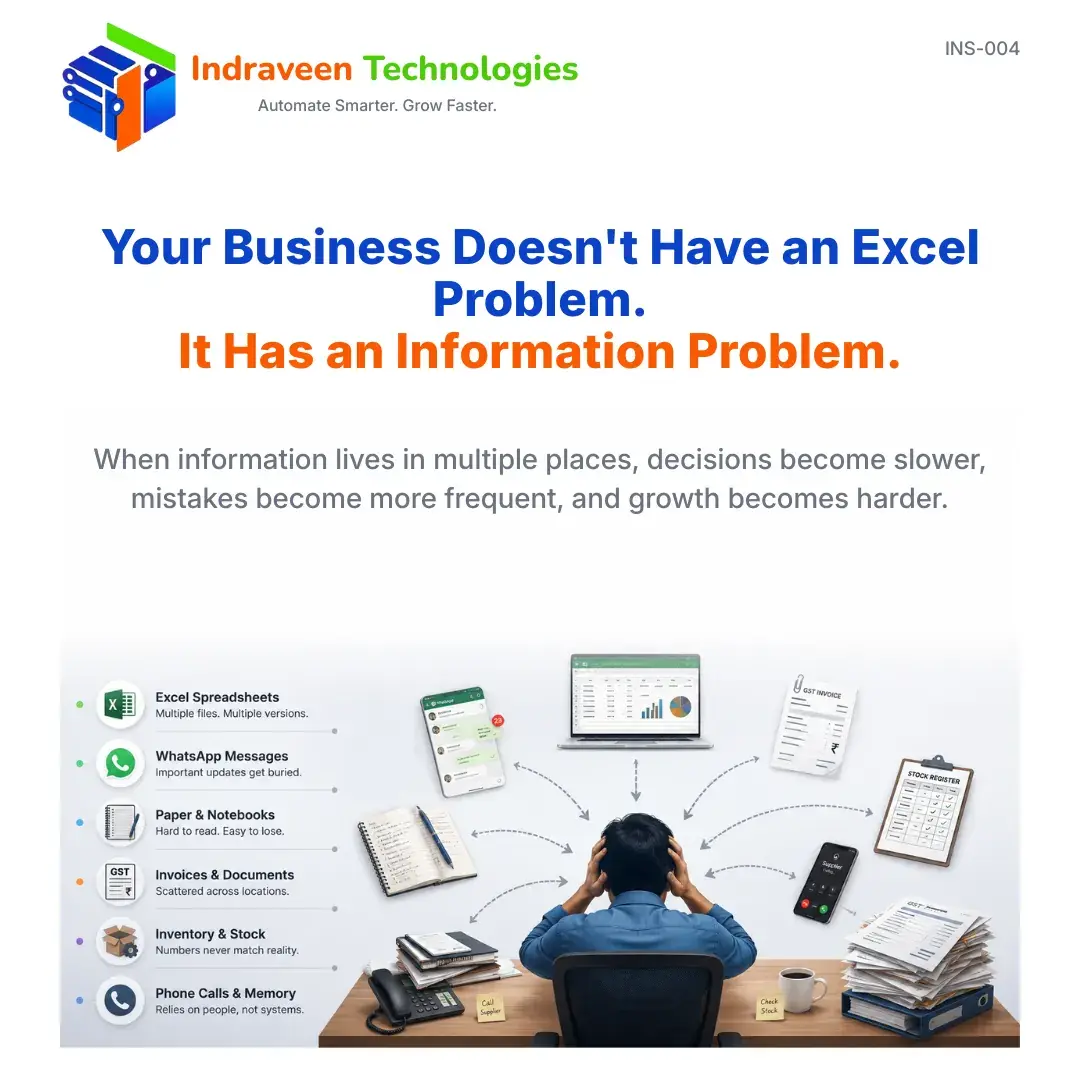
The Honeymoon Phase: Why Every Great Business Starts with Excel
Let’s establish one undeniable fact right away: Microsoft Excel is a masterpiece of business software.
When you are first building a business, you do not need complex, rigid enterprise systems. You need flexibility, speed, and a tool that adapts to your immediate reality. Whether you are opening a regional distribution centre, managing an automobile workshop, or running a logistics firm, a spreadsheet is the reliable engine that gets your operations off the ground.
In the beginning, Excel is the perfect operational partner because:
- It is infinitely flexible: You can build a daily dispatch register, a spare parts inventory tracker, or a customer directory in minutes, exactly the way you want to see it.
- It is cost-effective: There are no massive upfront licensing fees or expensive implementation consultants required.
- It is universally understood: You do not need an extensive training manual to teach a new hire how to log GST invoices or purchase registers into a grid. Almost anyone you hire knows how to use it.
In those early days, running your business on a combination of a master spreadsheet, a physical notebook on the shop floor, and a quick WhatsApp Business group is a completely sensible strategy. You did not make a mistake by building your company on this foundation.
But business growth has a funny way of breaking the very systems that made that growth possible.
What happens when your team expands? What happens when you go from processing twenty delivery challans a week to fifty a day?
Suddenly, that single master spreadsheet is duplicated by different departments. The WhatsApp group is flooded with fragmented voice notes about missing inventory. The physical notebook on the service floor is illegible to anyone except the person who wrote in it.
When this happens, you haven't outgrown Excel because Excel is a bad tool. You have outgrown it because your business has matured, and your critical operational information is now dangerously fragmented.
Industry Insight
The transition away from spreadsheets is not an IT upgrade; it is an operational necessity. As your transaction volume grows, the cost of managing data manually quickly eclipses the cost of investing in proper systems.
The Business Growth Journey: How Complexity Sneaks Up
It is a common misconception that operational complexity is tied directly to how many employees you have. In reality, complexity is tied to how many different places your information has to travel to get a job done.
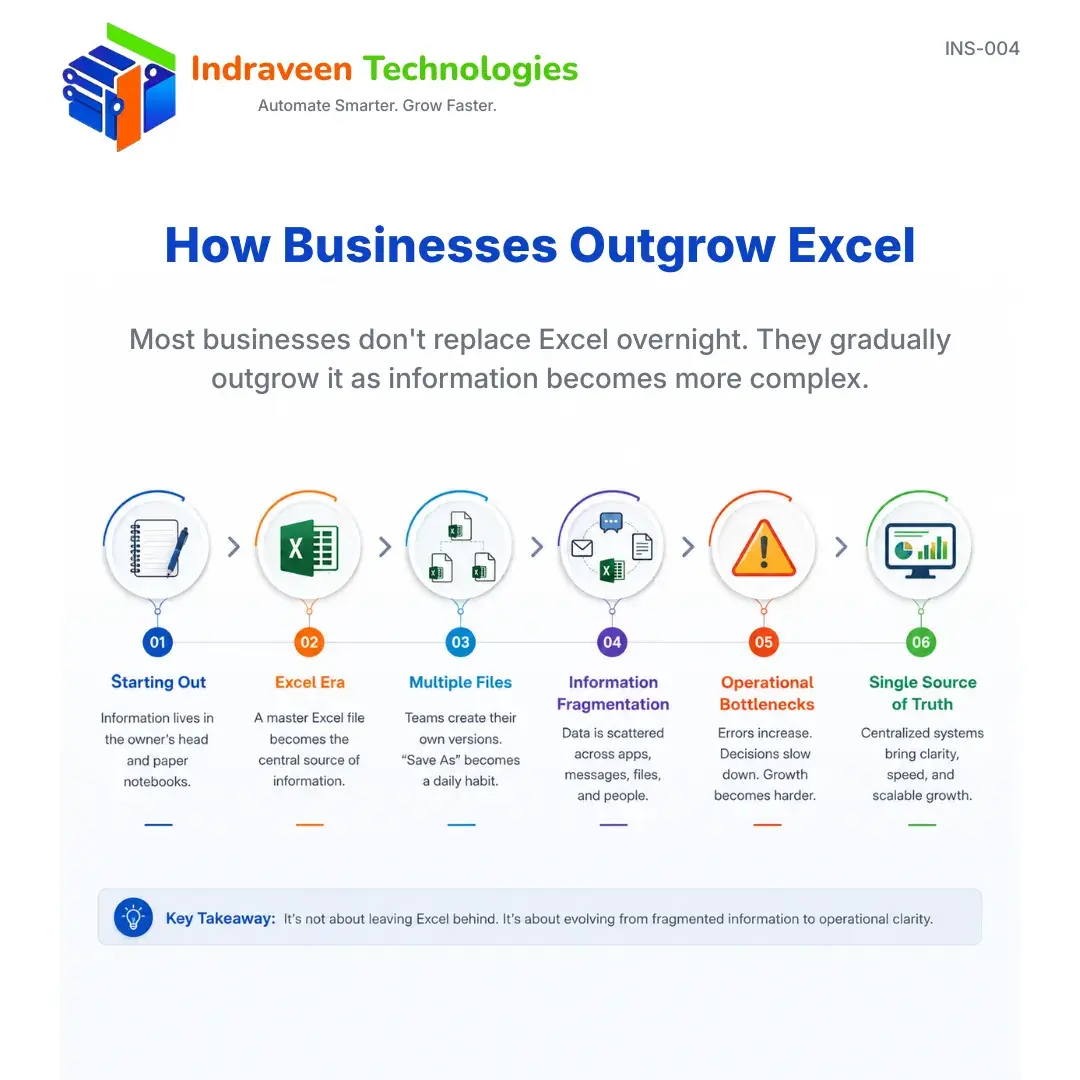
Growth doesn't happen overnight; it happens in stages. At each stage, the way your business handles information changes subtly, until one day, the system that used to feel effortless starts feeling like a heavy anchor.
Here is what the journey usually looks like for a growing business:
Stage 1: The Owner as the Database When you first start out, the entire business lives in your head and perhaps a single physical notebook. You know exactly what is in the spare parts inventory, you know which clients owe you money, and you know the status of every pending job. The system works perfectly because there are no communication handoffs.
Stage 2: The Master Spreadsheet Era As you bring on your first few employees, keeping everything in your head is no longer an option. You introduce a master Excel spreadsheet. It sits on the office computer, and it acts as your central hub. If a customer calls, your team checks the spreadsheet. If you need to contact local suppliers, you check the spreadsheet.
Stage 3: The Departmental Split (The "Save As" Problem) Your business continues to grow. You now have distinct roles—perhaps a dedicated sales executive, field technicians, and a dispatch coordinator. The master spreadsheet is suddenly too busy. Two people try to open it at the same time and get a "File is locked for editing" error.
To solve this, employees start downloading their own versions. The accounts team creates "GST_Invoices_August_V2.xlsx." The dispatch team makes a copy for their daily routing. Suddenly, your single source of truth has split into multiple documents that no longer talk to each other.
Stage 4: Complete Information Fragmentation This is the stage where operations outpace tools. Data is now trapped in silos across paper ledgers, phone calls, employee memories, and outdated spreadsheets. Your business is officially caught in the unstructured data trap.
Table 1: The Evolution of Operational Complexity
| Stage | Information System | Typical Challenge |
|---|---|---|
| 1. Owner Only | Memory & Notebooks | Highly efficient, but entirely unscalable. |
| 2. Small Team | Master Excel Sheet | File locking, limited concurrent access. |
| 3. Department Split | Multiple Excel Versions | Version confusion, duplicate data entry. |
| 4. Full Fragmentation | Excel, WhatsApp, Paper | High error rates, lost service history, communication breakdowns. |
Related Insight: Still Managing Your Business Manually?
The progression rarely happens overnight. As businesses grow, operational complexity increases in predictable stages. The illustration below summarizes how many MSMEs gradually outgrow spreadsheets—not because Excel fails, but because information becomes increasingly fragmented.
The Unstructured Data Trap
When your business enters Stage 4, you fall into the "unstructured data trap." This happens when your critical business intelligence is scattered across formats that cannot communicate with each other.
Instead of a smooth operational flow, your daily processes become a chaotic relay race of manual handoffs. Let's look at how this fragmentation actually plays out on the floor of a typical growing MSME.
Scenario 1: The Automobile Workshop A customer drops off a vehicle for a major service. The mechanic inspects the car and writes down the required replacements on a physical job card. The parts manager reads the card, sends a quick message on WhatsApp Business to local suppliers to check availability, and leaves a voice note for the owner regarding the price difference. Meanwhile, the administrative desk only updates the central Excel service history sheet at the end of the day.
At 2:00 PM, the customer calls the front desk for a status update. The receptionist opens the Excel sheet—which is completely outdated—and sees nothing. They have to put the customer on hold, leave their desk, walk across the noisy shop floor, and track down the mechanic just to find out if the brakes have been replaced yet.
What should have been a 10-second system check turns into 15 minutes of wasted time, a frustrated customer, and an interrupted mechanic.
Scenario 2: The Logistics and Distribution Business Your logistics company manages daily truck dispatches using a master spreadsheet. However, the reality of logistics is unpredictable. Last night, a driver called in sick. Your dispatch manager quickly arranged a backup driver over a phone call and scribbled the updated route and delivery challans into his personal diary. He didn't update the master Excel file because he was busy putting out the fire.
The next morning, the accounts team tries to process vendor payments based on the master spreadsheet, which still shows the original driver. Chaos ensues. More importantly, this creates a dangerous reliance on informal communication.
Table 2: The Impact of Manual Processes
| Manual Process | Business Impact |
|---|---|
| Physical Job Cards & Notebooks | Illegible handwriting leads to wrong parts being ordered or delayed service. |
| WhatsApp Business Approvals | Critical financial or operational approvals get buried in chat histories. |
| End-of-Day Excel Batch Entry | Real-time visibility is destroyed; the team is always acting on outdated data. |
| Phone Call Dispatch Updates | Only one person holds the operational truth, creating a single point of failure. |
The Tipping Point: The "Ask the Boss" Bottleneck
The most dangerous consequence of the unstructured data trap isn't lost files or delayed customer updates. It is a fundamental shift in how your business operates day-to-day. When your team can no longer trust the fragmented spreadsheets, WhatsApp messages, and paper ledgers, they naturally revert to the only reliable source of truth they have left: you.
This is how a growing business develops the "Ask the Boss" syndrome.
When an employee opens a spreadsheet and sees a spare parts inventory that doesn't match what is physically on the shelf, they stop trusting the system. To avoid making a mistake, they walk into your office and ask, "Boss, do we actually have the parts for this job?" When field technicians aren't sure if they are looking at the latest pricing sheet, they call you to confirm.
Suddenly, your day is consumed by answering micro-questions that your systems should be answering for you. You are no longer acting as the visionary of your company; you have been downgraded to a human database.
Key Takeaway
If your team has to constantly interrupt you to verify data that already exists in a spreadsheet or a notebook, your business has an information fragmentation problem, not a staffing problem.
The Fragility of Tribal Knowledge This bottleneck makes the entire business incredibly fragile. Research from Panopto indicates that roughly 42% of institutional knowledge is unique to the individual. This is known as "tribal knowledge."
If critical operational details—like how to handle a specific local supplier, which 14-wheeler truck route is actually active today, or what a VIP client prefers—only exist in your head or a manager's notebook, your business is always one sick day away from paralysis. Without centralized systems, you cannot delegate authority; you can only delegate tasks, while keeping all the mental burden on your own shoulders.
The Silent Costs of "Making it Work"
When a business is stuck in the unstructured data trap, the daily friction feels like the biggest problem. But the most dangerous cost of fragmented information is the cost you don't see until it is too late: human error and lost productivity.
Common Myth
"We're too small for business software."
Most businesses don't struggle because they adopted software too early.
They struggle because they waited until operational complexity had already outgrown their existing processes.
The right time to improve your systems is before manual work starts consuming your team's time.
The 94% Reality It is easy to assume that if you are careful, your spreadsheets are accurate. Decades of academic research prove otherwise. Across extensive field audits conducted by Professor Raymond Panko of the University of Hawaii, a staggering 94% of audited operational business spreadsheets contained errors.
In a spreadsheet with hundreds of rows of inventory, purchase registers, or GST data, a small error compounds. The probability of your master spreadsheet containing at least one material error isn't just possible—it is virtually guaranteed. (Even JPMorgan Chase lost $6.2 billion in 2012 due to a simple copy-paste formula error in an Excel risk model).
The 2.5-Hour Penalty These aren't just minor annoyances; they are massive financial leaks. Employees in fragmented environments spend an average of 2.5 hours every single day just searching for information. That is nearly a third of your payroll completely wasted on employees hunting down files, deciphering handwritten delivery challans, and interrupting each other.
Furthermore, research reveals that manually processing a single invoice costs a business roughly $22 (accounting for labor, chasing approvals, and resolving mistakes). When automated, that cost drops to $6.90. If you are manually processing hundreds of invoices a month, you are bleeding capital.
Have You Outgrown Excel? A Self-Assessment
Before looking at solutions, take a moment to evaluate your current operations. If you check more than three of the boxes below, your business has likely outgrown spreadsheet-based management:
- Multiple Versions: Your team regularly asks, "Which version of the file is the correct one?"
- The "Ask the Boss" Syndrome: You spend more than two hours a day answering operational questions that should be documented.
- Inventory Mismatches: Your digital inventory almost never perfectly matches your physical shop floor.
- Missing Customer History: Finding a customer's previous service history requires searching through multiple files or paper ledgers.
- WhatsApp Dependency: Critical business approvals and vendor quotes are buried in WhatsApp Business chats.
- Duplicate Data Entry: Your staff types the same information into a job card, then a spreadsheet, and then a billing system.
- Delayed Responses: Customers are frequently put on hold while staff walk across the floor to check on job statuses.
- End-of-Month Chaos: Preparing monthly reports or GST filings requires days of manual reconciliation.
What Modern Businesses Do Differently
When you finally realize that "making it work" is holding your business back, the temptation is to immediately search for trendy software. But the specific software isn't the solution. The solution is changing how your business handles information.
The "Single Source of Truth" Modern, scalable businesses operate on a principle known as a Single Source of Truth (SSOT). This simply means that every piece of critical business information exists in only one place.
When your business operates with a single source of truth:
- The field technician logs the required parts into a system from a mobile device directly at the site.
- The parts manager immediately sees that requirement on their screen, checks inventory, and orders the part.
- The receptionist can look at the same system five minutes later and tell the customer exactly where the repair stands.
- The owner can pull up a dashboard from anywhere and see the day's revenue and dispatch statuses in real-time.
There is no "Dispatch_List_Final_V3.xlsx." Everyone is looking at the same reality.
Table 3: Fragmented vs. Centralized Operations
| Feature | Fragmented Operations | Centralized Operations (Single Source of Truth) |
|---|---|---|
| Data Storage | Spread across notebooks, local drives, and phones. | Secured in a single, unified database accessible from anywhere. |
| Information Flow | End-of-day batch entry; always acting on old data. | Real-time updates captured at the point of work. |
| Decision Making | High dependency on the owner's "gut feel" and memory. | Data-driven dashboards reflecting actual operational reality. |
| Scalability | Breaks down as transaction volume increases. | Easily handles increased volume without adding administrative overhead. |
Solution: Businesses facing these operational challenges often adopt workflow automation platforms or custom business applications to bridge the gap between their manual processes and their growth ambitions.
The Emotional Toll of Fragmented Systems
Take a step back and remember why you started your business in the first place.
You didn't take on the immense risk of entrepreneurship just to spend your evenings reconciling purchase registers. You didn't build a team just so you could spend your days acting as a human database, answering the exact same operational questions week after week.
Technology is supposed to give business owners freedom. It is supposed to handle the administrative heavy lifting so that you can focus on strategy, expansion, and customer relationships. When you rely on fragmented spreadsheets and paper ledgers, your business ends up running you, rather than you running your business.
Conclusion: Reclaiming Your Time and Scaling the Right Way
As your MSME crosses into its next phase of maturity, the complexity of your operations will only increase. If you try to manage that new complexity with the same notebooks and disconnected Excel files you used on day one, you are not just stunting your company's growth; you are choosing to remain the ultimate bottleneck.
Moving away from spreadsheets is not an indictment of Excel. Excel was the necessary scaffolding that allowed you to build the house. But you cannot live in the scaffolding forever.
True digital transformation is simply about centralizing your information. When you eliminate the unstructured data trap, you eliminate the daily friction. You stop the duplicate data entry. You stop losing customer history. And most importantly, you stop the constant "Ask the Boss" interruptions.
You built your business to achieve freedom. By upgrading from a fragmented system to a centralized one, you aren't just modernizing your operations; you are reclaiming your time, empowering your team, and building a foundation strong enough to support your true potential.
Where Do You Go From Here?
Every growing business eventually reaches a point where its operational systems need to evolve.
For some businesses, an off-the-shelf solution is enough.
For others, the way they operate is unique enough that a tailored workflow or custom business application delivers far greater long-term value.
The important first step isn't choosing software.
It's identifying where your information flow is slowing your business down.
If you'd like an objective discussion about your current workflows, operational bottlenecks, and opportunities for improvement, we'd be happy to help you evaluate them—without any obligation or sales pressure.