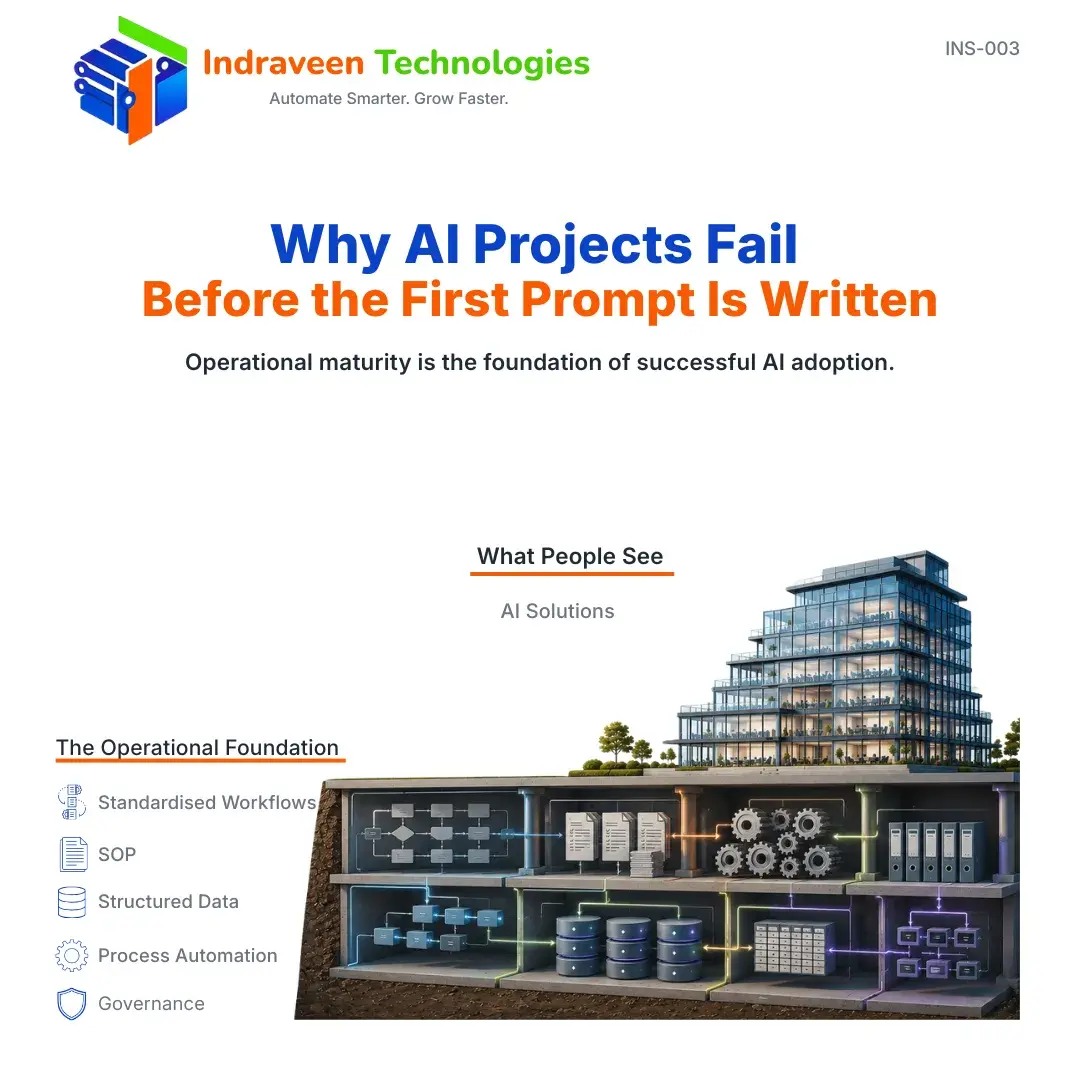
I. The AI Mirage in the MSME Ecosystem
If you turn on tech news or scan corporate market reports today, Artificial Intelligence is presented as a generational magic wand. Business leaders across India are under immense pressure to adopt AI or risk immediate obsolescence.
Yet, behind the marketing headlines, the implementation statistics tell a very different story.
A landmark study by the RAND Corporation revealed that over 80% of enterprise AI projects fail—nearly double the failure rate of traditional corporate IT projects. Furthering this reality, MIT’s Project NANDA evaluated over 300 generative AI initiatives across various industries and found that a staggering 95% of organisations saw zero measurable return on investment from their pilot programs.
While the reported failure rates vary across research organisations due to differences in methodology and sample selection, the underlying conclusion remains remarkably consistent. Most unsuccessful AI initiatives are not caused by weak AI models, but by unclear business objectives, poor-quality operational data, fragmented processes, weak governance and unrealistic implementation expectations.
Complementing these findings, Gartner projects that up to 60% of AI initiatives will be abandoned through 2026 due to a fundamental lack of operational "AI-ready data," while IBM’s CEO Study indicates that only 16% of AI initiatives successfully scale enterprise-wide.
Although each study evaluates AI adoption from a different perspective, they collectively reinforce a common operational lesson: organisations that treat AI as a technology purchase consistently underperform those that first invest in process maturity and reliable business data.
The Corporate Failure vs. The MSME Reality
These failure rates are not happening because the underlying machine learning models are broken, or because engineers lack technical expertise. They happen because organisations attempt to force advanced algorithms onto broken, informal, or completely undocumented business operations.
When an enterprise with millions of dollars in disposable IT budget fails at an 80% to 95% rate, it highlights a critical lesson for small and medium enterprises (MSMEs):
Businesses don't fail at AI because they chose the wrong technology. They fail because AI can only scale a process that already exists, is understood, and is consistently executed.
For a mid-market manufacturer, a regional distributor, or a B2B service provider, buying an AI subscription or rushing to build a custom tool without first organizing daily operational workflows is an expensive mistake. To build actual software value, a business must step away from the hype and understand the operational maturity curve required for digital transformation.
Industry Insight
Before spending a single rupee on AI software, a business must ask a foundational question:
Can a new employee execute your entire workflow consistently using documented procedures without depending on the founder or a senior employee?
II. The 5-Stage Operational Maturity Model
For an MSME, digital transformation is not an overnight purchase; it is a step-by-step evolution. Jumping directly from paper records to artificial intelligence is the primary reason software projects stall.
To achieve sustainable efficiency, a business must move through five distinct stages of operational maturity:
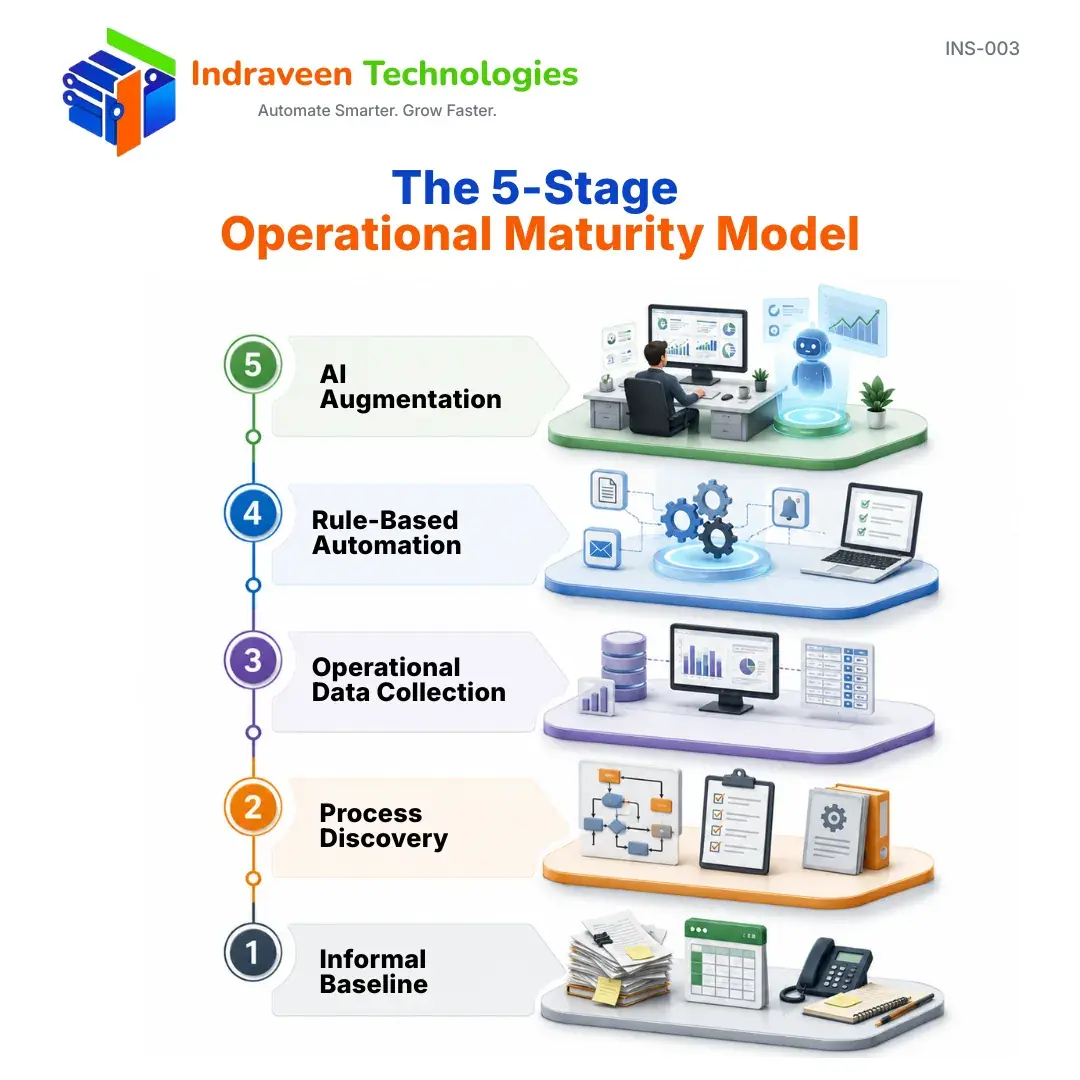
| Operational Stage | Data Structure | System Reliance | Primary Risk |
|---|---|---|---|
| 1. Informal Baseline | Unstructured (Paper, WhatsApp) | Individual Memory | High operational friction & revenue leaks |
| 2. Process Discovery | Documented Workflows | Standard Operating Procedures | Operational pushback during standardisation |
| 3. Operational Data Collection | Structured Digital Records | Centralized Software / PWAs | Staff falling back to parallel manual entry |
| 4. Rule-Based Automation | Validated Real-Time Data | Automated Triggers (If/Then) | Automating an unverified or flawed process |
| 5. AI Augmentation | Clean Historical Baselines | Predictive & Generative Models | Expecting AI to fix baseline operational logic |
Stage 1: The Informal Baseline (The Quiet Cost of Manual Operations)
Manual work rarely feels expensive on a day-to-day basis. It simply consumes hours quietly in the background.
In a typical MSME, operations run almost entirely on informal communication:
- Order details, change requests, and approvals live inside scattered WhatsApp text threads and voice notes.
- Inventory levels or operational capacities are verified by physically calling a yard supervisor or floor manager.
- Job statuses, billing notes, and customer records exist on spreadsheets stored locally on individual laptops or scribbled in physical ledgers.
At this stage, the business operates on zero structured data. Operations depend entirely on "hero syndrome"—a few key employees or the business owner keeping all operational logic inside their heads.
Attempting to introduce AI at Stage 1 leads to immediate failure. AI algorithms require structured, predictable input data. If the input data is fragmented across physical notebooks and personal phones, the AI has nothing to process.
Stage 2: Process Discovery (The Whiteboard Phase)
Before a single line of code is written or a software vendor is hired, a business must map its operational reality. Process discovery requires no technology—it requires a whiteboard, key operational staff, and an honest assessment of daily activities.
Workflow mapping forces a business to define clear triggers, handoffs, and verification points across four main operational phases:
- Intake & Validation: What exact information must be collected and verified before a customer order or job is accepted?
- Resource Allocation: Who checks inventory or capacity, and how is work formally assigned to the execution team?
- The Operational Handoff: What specific trigger moves a task from "In-Progress" to "Quality Check" or "Completed"?
- Completion & Settlement: How does the administrative or finance desk definitively confirm that work is finished before issuing an invoice?
standardisation transforms informal tasks into a repeatable sequence. It eliminates ambiguity, ensuring that operations run smoothly regardless of who is managing the shift.
For many businesses, this stage also results in the creation of their first Standard Operating Procedures (SOPs). These documented procedures reduce dependency on individual experience and provide the consistency required for future automation and AI initiatives.
Stage 3: Operational Data Collection (Building the Digital Baseline)
Once a process is mapped, it can finally be digitized. Stage 3 is not about deploying massive enterprise software; it is about implementing simple, dedicated systems that capture the standardised workflow in real time.
The primary objective of Stage 3 is structured data generation:
- Operational updates occur within a centralized system rather than through verbal calls or unrecorded chats.
- Financial settlements, job logs, and material tracking leave a digital footprint at the exact moment the activity occurs.
Equally important is establishing basic data governance. Customer records, inventory updates, operational events and financial transactions should be captured consistently using agreed formats. AI systems depend far more on trustworthy historical data than on sophisticated algorithms.
Over weeks and months, this system builds a clean, historical baseline. For the first time, the business owner can see actual operational metrics—such as true task completion times, recurring bottlenecks, and material waste patterns—backed by reliable data rather than memory.
Stage 4: Rule-Based Automation (Fixing the High-Friction Points)
A common misconception in modern business is that every operational issue requires artificial intelligence. A significant proportion of daily operational friction in growing businesses can often be eliminated using deterministic, rule-based automation long before artificial intelligence becomes necessary.
Rule-based automation operates on clear logic: If Event A occurs, execute Action B automatically.
- Automated Client Updates: When a job status is marked "Ready for Pickup" by an operator, an automated notification is instantly sent to the customer.
- Inventory Threshold Alerts: When raw material inventory drops below a pre-set reorder point, a purchase request is automatically flagged for procurement.
- Systematic Expense Logs: When a field employee submits a standardised trip expense, it is automatically routed to the finance queue for reconciliation.
Rule-based automation removes repetitive administrative work, speeds up internal communication, and delivers immediate ROI without the expense or complexity of AI models.
Stage 5: AI Augmentation (Enhancing a Functioning Foundation)
Only when a business reaches Stage 5 does AI become a viable, high-ROI investment.
Because the business now possesses standardised workflows (Stage 2), clean operational data (Stage 3), and automated communication pipelines (Stage 4), AI can act as a true force multiplier rather than a chaotic patch.
- Predictive Planning: Instead of guessing future raw material needs, machine learning models analyze months of clean historical data to forecast inventory demand based on seasonal trends.
- Context-Aware Assistance: Instead of a basic chatbot that frustrates users, an AI model trained on the company’s structured internal database can instantly answer complex operational questions for staff or clients.
At this final stage, AI enhances human decision-making because it operates on a stable, structured foundation.
Successful organisations also tend to begin with narrowly defined AI use cases rather than enterprise-wide transformation programmes. Solving one measurable business problem—such as demand forecasting or document classification—creates organisational confidence before expanding AI adoption across additional workflows.
III. Why Good Businesses Still Struggle with Software
It is a common sight across the Indian MSME landscape: an experienced business owner invests in software, only for the staff to abandon it six months later in favor of physical notebooks and Excel.
Software implementations rarely fail due to lack of staff intelligence. They fail because of a structural mismatch between the software design and the ground reality.
Across industries, software projects often expose operational inconsistencies that already existed rather than creating new ones. Technology simply makes those inconsistencies more visible by requiring decisions, responsibilities and workflows to be explicitly defined.
Remember
Software alone cannot compensate for unmapped processes or informal habits.
Technology amplifies your underlying operations: if you automate a well-defined process, you gain speed. If you automate chaos, you simply get faster chaos.
The Unstructured Data Trap
AI and traditional software run on structured data (tables, databases, predefined fields). MSMEs typically run on unstructured data (voice notes, paper receipts, free-form text messages).
When software forces employees to spend hours manually converting unstructured conversations into rigid software entries without offering them immediate operational value, adoption fails. Staff view the software as extra administrative homework rather than a tool that helps them get work done.
The Hero Syndrome Bottleneck
When business processes exist only in the minds of a few key individuals, the organisation cannot scale. Every decision, approval, and override requires constant phone calls. Software implemented in this environment quickly becomes obsolete because employees bypass system rules to maintain their informal, habit-based ways of working.
This concentration of operational knowledge creates organisational risk. Staff absences, resignations or business expansion become increasingly difficult because critical decisions cannot be delegated or consistently repeated.
IV. What Progressive MSMEs Are Doing Differently
While many businesses get caught in the cycle of buying software and abandoning it, progressive MSMEs are taking a more disciplined approach to digital transformation.
Instead of chasing tech trends, market leaders focus on operational architecture first.
Key Takeaway
Sustainable profitability and smooth scaling rarely come from buying more complex software. They come from systematically removing daily operational friction.
1. Separating Process Logic from Technology
Progressive operators recognize that software is merely an execution layer. Before evaluating software vendors, they clearly map their internal procedures on paper. They decide how work should flow, how handoffs occur, and where accountability lies—ensuring the business dictates the software requirements, rather than letting software dictate how the business operates.
2. Measuring Operational Micro-Metrics
Rather than looking solely at monthly revenue or gross margin, forward-thinking operators track process-level metrics:
- What is the average time taken between job completion and invoice generation?
- Where do jobs spend the most idle time during internal handoffs?
- How many operational queries require the business owner's direct intervention daily?
By measuring these micro-metrics, businesses identify exact friction points and address them with targeted process adjustments or lightweight digital tools.
3. Prioritizing Friction Reduction Over Feature Count
The value of a digital tool is not measured by the number of features on its spec sheet, but by how easily it fits into daily operations. Successful implementations focus on solving one or two high-pain problems first—such as trip reconciliation or shift tracking—before expanding system scope.
V. When Off-the-Shelf SaaS Fails Ground Reality
The global software market is dominated by off-the-shelf Software-as-a-Service (SaaS) platforms designed primarily for Western enterprises or large corporate setups.
Many enterprise SaaS platforms are designed around operational assumptions that work extremely well for large organisations but may not always align with the realities of smaller or field-based businesses:
- They assume dedicated IT managers, finance teams, and dispatch desks.
- They assume continuous high-speed internet connectivity across all work sites.
- They assume employees sit at office desks using desktop screens throughout the workday.
For an MSME operating in Tier 2 or Tier 3 industrial corridors, these assumptions rarely hold true.
Field managers, drivers, technicians, and floor staff are constantly on the move, often working in environments with spotty network coverage. When an off-the-shelf SaaS system forces these workers to navigate complex dropdown menus or requires continuous connectivity to log basic updates, employees simply stop using it.
When software introduces more administrative effort than operational value, employees naturally revert to familiar tools such as spreadsheets, notebooks or messaging applications.
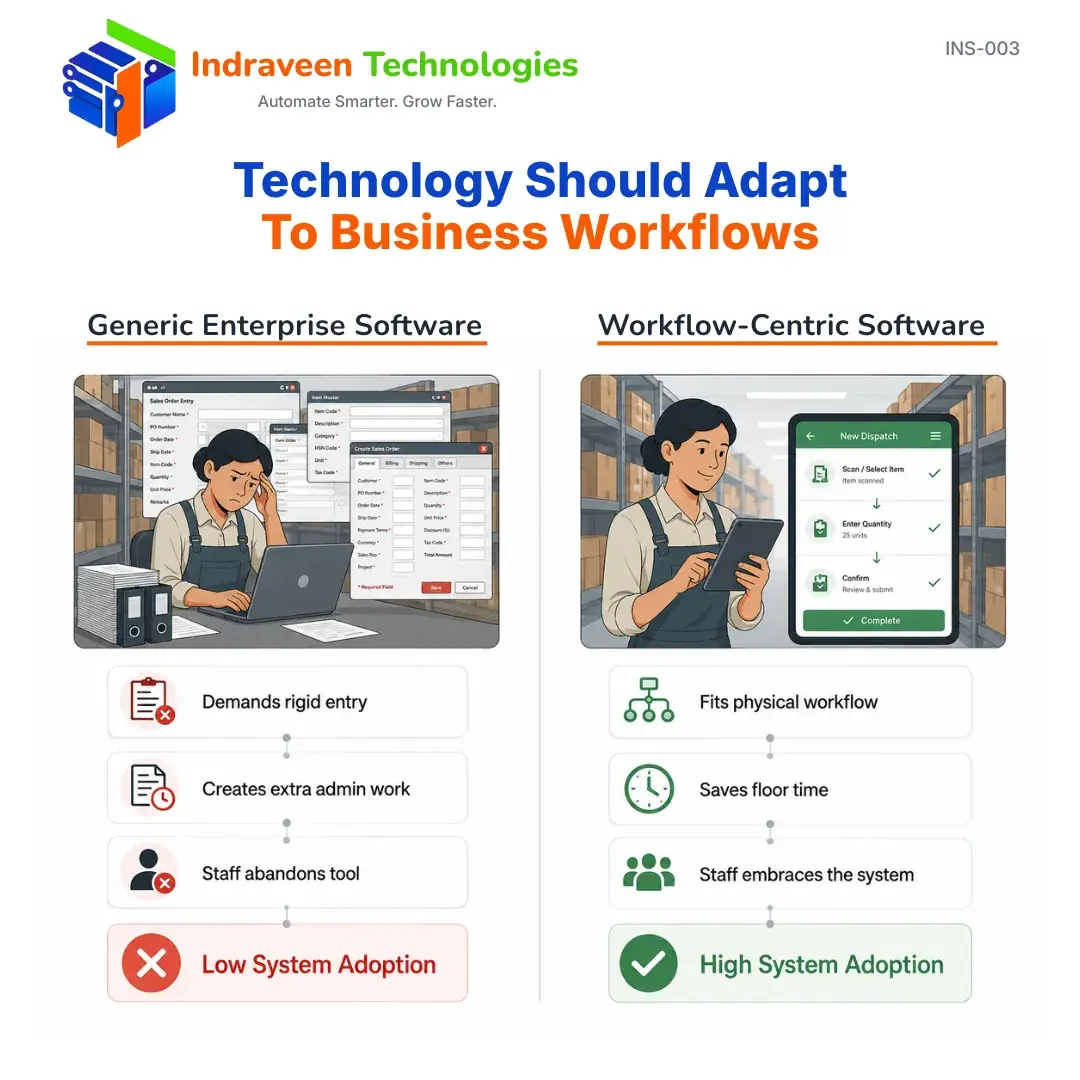
For digital transformation to succeed on the shop floor, technology must adapt to the physical operating reality of the business—not the other way around.
VI. Building for Ground Reality: A Business Perspective
At Indraveen Technologies, we believe that true digital transformation starts long before a single line of software code is written. It begins on the business floor, understanding how information, assets, and people move through an organisation.
Every industry develops its own operational rhythm based on years of practical experience. Technology provides its highest ROI when it respects and strengthens those natural rhythms, rather than forcing a business into rigid corporate templates designed for entirely different environments.
The Indraveen Technologies Approach
Our philosophy is built on process-first software architecture:
- Process Discovery First: We begin by mapping your actual operational reality—identifying where communication breaks down, where data gets trapped on paper, and where manual tasks quietly bleed time and money.
- Context-Aware Software Design: We design lightweight, highly accessible applications (including offline-first Progressive Web Apps) that allow field staff and operators to capture data instantly at the moment work happens, regardless of network stability.
- Structured Data Foundations: We focus on converting scattered, informal communication into clean, structured historical records—laying the baseline required for future automation and AI tools.
- Pragmatic Automation: We prioritize solving immediate, high-friction operational bottlenecks with reliable, rule-based systems before introducing complex machine learning logic.
Our objective is to design software that aligns with existing business operations, removes unnecessary friction and gradually builds the structured data foundations required for future automation and AI adoption.
Our goal is to build pragmatic technology that quietly eliminates operational friction, gives owners complete visibility over their business, and builds a solid foundation for sustainable growth.
Frequently Asked Questions
References
- RAND Corporation (2024). The Root Causes of Failure for AI Projects.
- MIT Project NANDA (July 2025). The GenAI Divide: State of AI in Business 2025.
- Gartner (2024–2026). Data & Analytics Summit Research and AI Adoption Forecasts.
- IBM Institute for Business Value (Q4 2025). Global CEO Study: Scaling Enterprise AI.
- McKinsey & Company (2025). The State of AI: Global Survey 2025.