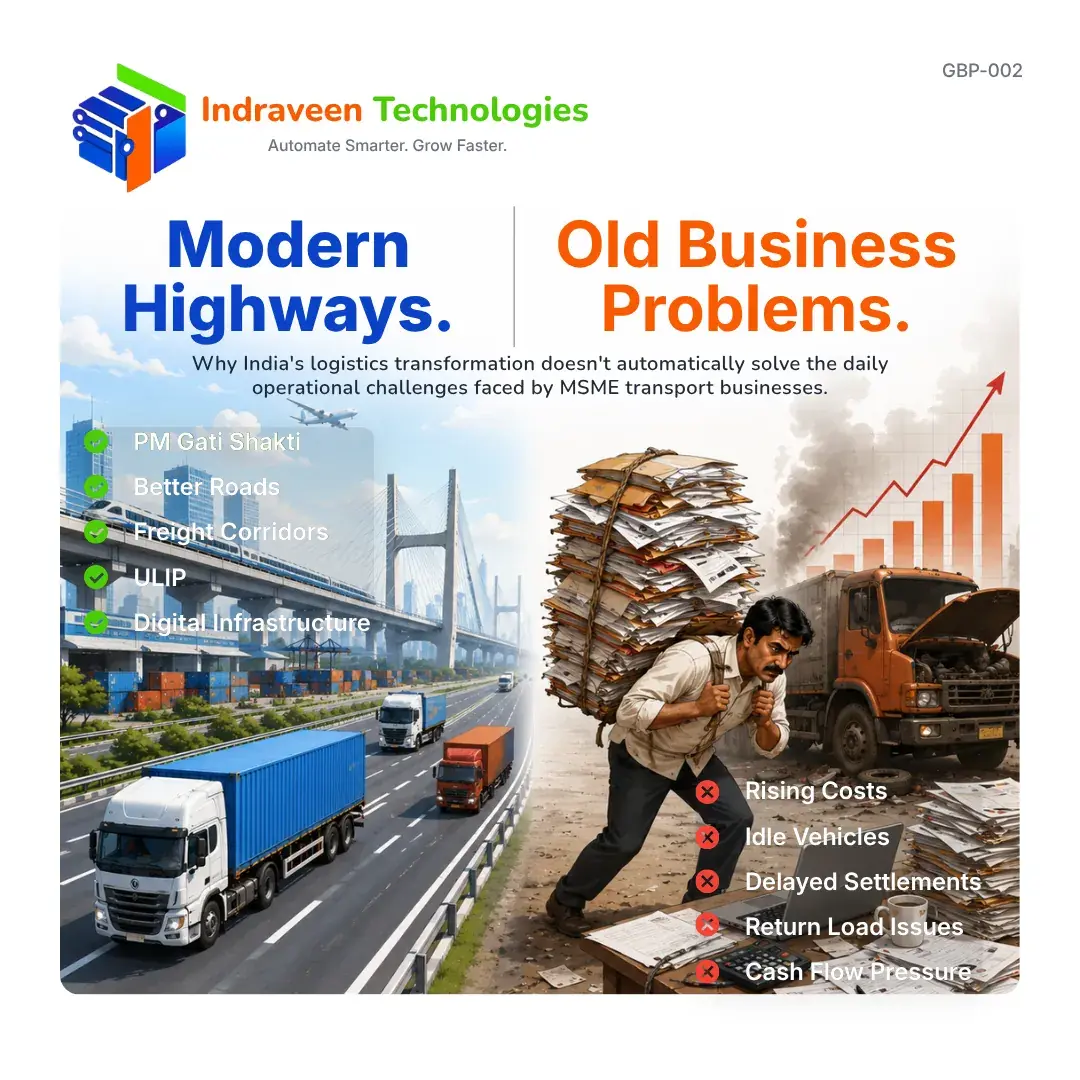
I. The Two Indias of Logistics
If you read the latest macro-economic reports, the Indian logistics sector has never looked better.
For the last decade, it was a widely accepted industry gospel that India’s logistics cost hovered between 13% and 14% of its GDP—a crippling expense that made Indian goods less competitive globally. However, a recent, landmark DPIIT-NCAER comprehensive study has officially pegged the national logistics cost at an impressive 7.97% of GDP.
This drop is not an accident. It is the result of massive, centralized government interventions acting on two main fronts:
- Physical Integration (PM Gati Shakti): A national master plan forcing over 16 ministries to plan infrastructure collaboratively. Instead of fragmented road-building, it focuses on Dedicated Freight Corridors and Multi-Modal Logistics Parks (MMLPs), shifting heavy freight to cheaper rail networks and reducing transit times.
- Digital Integration (ULIP): The Unified Logistics Interface Platform acts as a digital gateway, integrating APIs from FASTag, Vahan, railways, and customs into a single window for enterprise-level freight visibility.
On paper, freight is moving faster, cheaper, and more transparently than ever before.
The Macro Benchmark vs. The Micro Reality
But there is a catch. That 7.97% is a national average. It includes the highly efficient rail networks, coastal shipping, enterprise-managed warehousing, and last-mile delivery vans.
When you zoom in on the specific demographic that actually moves the majority of India's road freight—the MSME fleet owners operating out of Tier 2 and Tier 3 transport hubs—the picture changes dramatically. The NCAER data itself reveals a stark reality: logistics costs for small and micro firms are significantly higher as a percentage of their output compared to large corporations.
There are two Indias when it comes to logistics. There is the India of sprawling enterprise supply chain dashboards leveraging ULIP APIs, and then there is the India of the independent transporter running a fleet of rigid-body trucks across state lines.
For an MSME operator running a 14-wheeler or 18-wheeler truck, the national drop in logistics costs rarely translates into fatter margins. In fact, while the country's overall costs are going down (largely due to better highways and rail shifts), the independent fleet owner's daily operational complexities are going up. They aren't logging into PM Gati Shakti to negotiate with a broker in a dusty holding yard, and they aren't using ULIP to reconcile a driver's missing toll receipts.
Industry Insight
To understand where the industry is actually bleeding cash, you have to stop looking at the national APIs and look directly at the daily operational reality of the fleet owner.
II. The Reality of Running a Fleet: The PTPK Squeeze and The Load-Finding Maze
Let’s step away from macro policy and look at the actual math of running a transport business. According to recent DPIIT-NCAER framework assessments, the cost of moving freight on Indian roads is heavily dictated by economies of scale.
The variance in cost Per Tonne Per Kilometer (PTPK) is staggering: for light, low-axle trucks, the operational cost sits at a punishing ₹11.03 PTPK. In contrast, heavy-duty 55-tonne trailers run at a highly efficient ₹1.51 PTPK on major trunk routes.
For an MSME fleet owner, the margin game in long-haul transport is razor-thin. When they choose between a 14-wheeler and an 18-wheeler rigid-body truck, they aren't just buying hardware—they are locking themselves into a specific operational risk profile right in the middle of this PTPK squeeze.
| Operational Metric | 14-Wheeler Rigid Truck | 18-Wheeler Rigid Truck |
|---|---|---|
| Gross Vehicle Weight (GVW) | ~42 Tons | ~47.5 Tons |
| Typical Payload Capacity | ~28 Tons | ~33 Tons |
| Fuel Economy (Loaded) | Moderately flexible | Highly sensitive to weight & idling |
| Load Flexibility | High (Easier to fill on secondary routes) | Low (Requires heavy industrial freight) |
| Holding Cost Sensitivity | Moderate | High (Higher EMI & idle fuel loss) |
The Cost Breakup and The Myth of the "Empty Return"
To understand where a fleet owner's margin actually goes, we have to look at the official cost breakdown of road transport:
- Fuel (42.1%): The largest unavoidable operating expense.
- Annual/Fixed Costs (40.5%): Administrative expenses, vehicle EMIs, insurance, and permit fees.
- The "Friction Bucket" (16.2%): Tolls (6.9%), driver/support staff (4.7%), and miscellaneous expenses (4.6%).
That 40.5% fixed cost is the silent killer. Outsiders often assume that if a truck doesn't get a return load, it simply drives back empty. In reality, because 40.5% of the vehicle's cost basis ticks away every single day—whether the truck is moving or parked—no long-haul operator can afford a deadhead trip of 800 kilometers unless both legs were pre-paid at premium spot rates (which is rare).
Instead, fleet owners face the Load-Finding Maze:
-
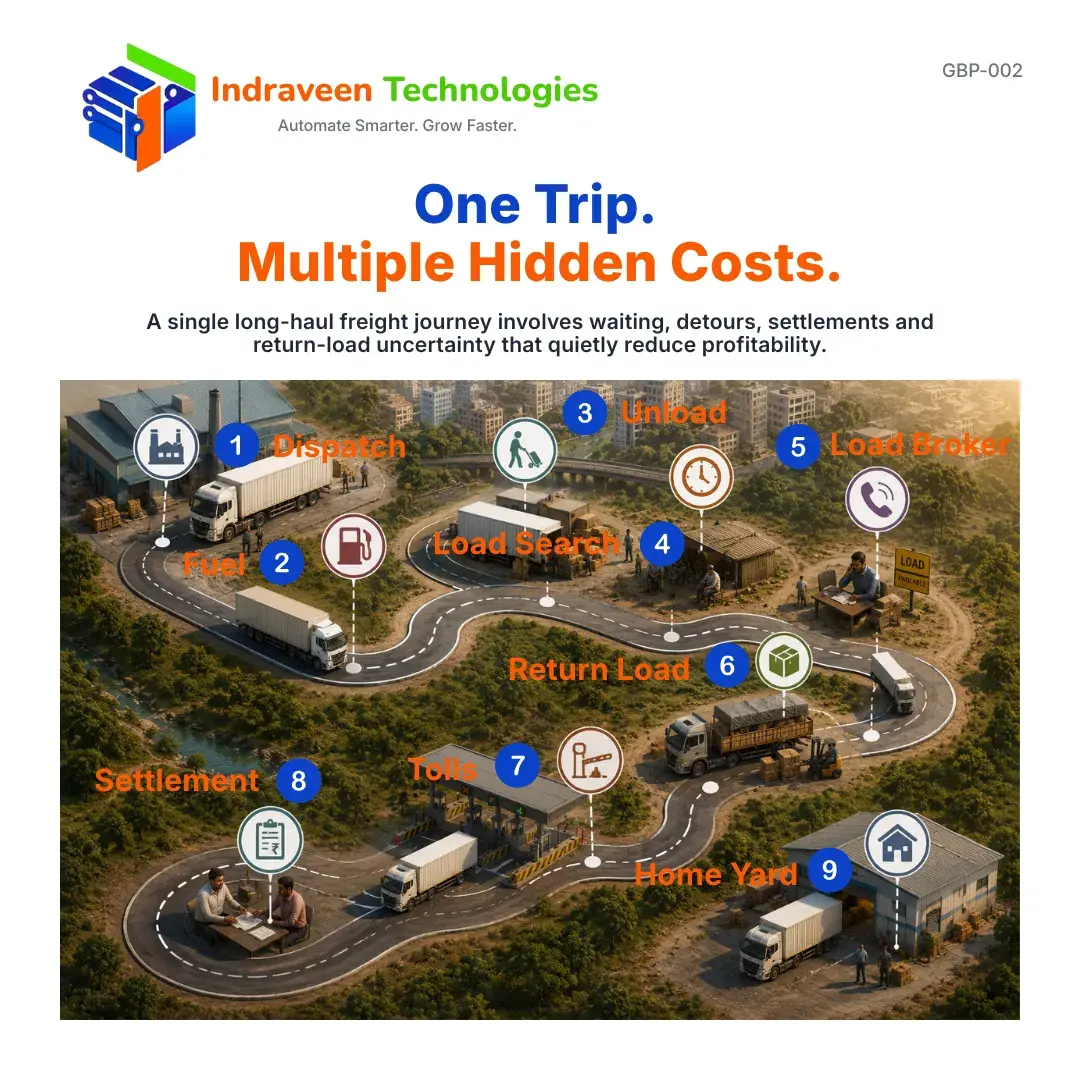
The Regional Imbalance & The Waiting Game: Finding a load depends heavily on geography. While the industrialized Western region exhibits lower transportation costs due to established freight bases, sending a truck to the Northeast introduces severe infrastructural bottlenecks and return-load challenges. After offloading cargo in a destination city, a driver might spend two to three days parked at a transport hub waiting for a broker match. Every day spent idling incurs driver allowances, parking fees, and lost opportunity cost on the vehicle's monthly EMI.
-
The Multi-Leg Detour: If a direct return load isn't available, the transporter is forced to "stitch" together a multi-leg journey. A truck might take a partial load from Mumbai to Bengaluru, wait another day, pick up industrial goods from Bengaluru to Kerala, and finally secure a load from Kerala back to Tamil Nadu.
-
The 18-Wheeler Capacity Trap: While an 18-wheeler boasts superior per-ton economics on major trunk routes, its advantage crumbles during multi-leg detours. Finding 33 tons of continuous freight between secondary Tier 2 cities is significantly harder than filling a 28-ton 14-wheeler.
The Paperwork and Cash Drift
While fleet owners obsess over fuel efficiency (42.1%), the real administrative chaos happens in the 16.2% "Friction Bucket" (tolls, driver expenses, and miscellaneous costs).
A single 12-day multi-leg trip involves multiple brokers, varying payment terms, toll cash advances, diesel slips, and unverified loading receipts. When a driver returns to the home yard after four stops across three states, reconciling the trip becomes a manual nightmare. Receipts are crumpled or lost, broker commissions are disputed, and cash advances are difficult to track.
Revenue leaks not because the trucks are slow, but because managing the operational trail of a multi-stop route on paper and informal chat groups is nearly impossible.
Key Takeaway
The government is successfully optimizing the highways, but the MSME fleet owner is left struggling with the holding yards.
You cannot outrun a 40.5% fixed cost with an idle truck, and you cannot scale a business if 16% of your operational expenses are managed in a paper notebook.
III. Why Good Businesses Still Struggle
It is a harsh truth in the transport sector: you can know truck mechanics inside out, map the most fuel-efficient routes, and still watch your business slowly bleed cash.
Good transport businesses do not usually fail because of a sudden catastrophic event. They struggle because of death by a thousand administrative cuts. The primary culprits are not the trucks themselves, but the systems used to manage them.
Remember
Good transport businesses do not usually fail because of a sudden catastrophic event. They struggle because of death by a thousand administrative cuts.
The Cash Flow Chokehold
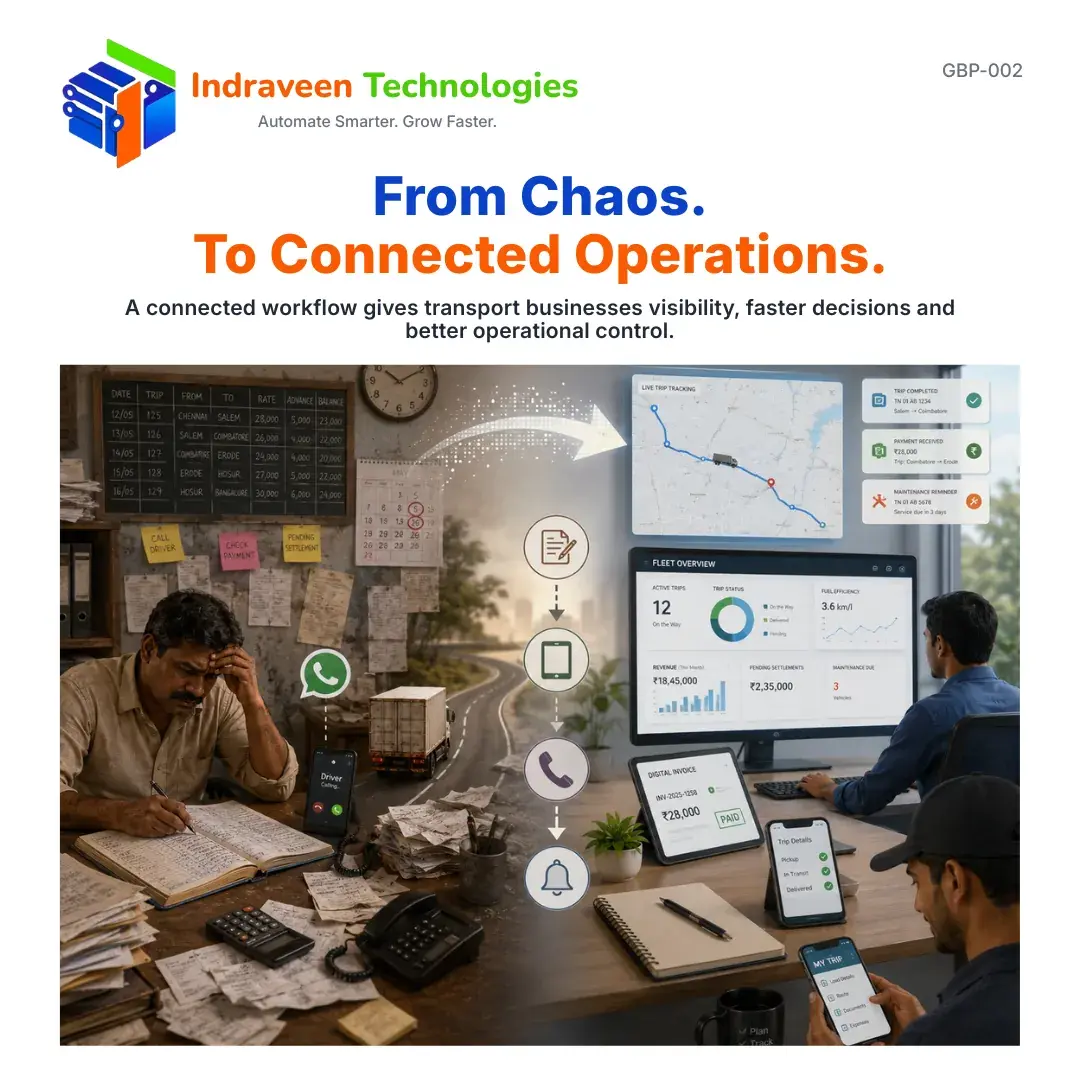
In a multi-leg journey, working capital gets trapped on the highway. Fleet owners are constantly advancing cash for diesel, tolls, and driver food allowances. However, trip settlements—the actual reconciliation of what was spent versus what was billed to the broker—often take days or even weeks after a truck returns. When trip data lives in fragmented WhatsApp voice notes, lost toll receipts, and smeared notebook pages, calculating exact profitability per trip becomes a forensic exercise. While the owner is busy doing the math, the next truck needs cash to roll out.
The Driver Disconnect
The chronic shortage of commercial drivers is well-documented, but the hidden cost is driver turnover and management. Fleet owners aren't just managing freight; they are managing people across vast distances. When disputes arise over undocumented cash advances or unlogged shift hours, trust breaks down. Drivers leave for operators who offer clearer, faster settlements, leaving the fleet owner with idle assets in the yard.
The "Black Box" Operations
Once a truck leaves the transport yard, it effectively enters a black box. Without a structured process, fleet owners rely on phone calls to know if a truck is stuck at a loading dock or idling at a state border. You cannot optimize a process you cannot see, and you cannot scale a business that relies entirely on the owner's memory and constant phone calls.
The Highway Tax (Official and Otherwise)
Anyone operating on Indian highways knows the realities of state borders and checkposts. Beyond official tolls, industry reports consistently highlight unwarranted stoppages by RTOs and highway police as a major cause of cargo delays and margin erosion. For a fleet owner, this "informal" highway friction is a taboo subject, but a very real line item on the P&L. When drivers track these expenses on paper or through frantic phone calls, the money simply vanishes into the generic bucket of "trip expenses." Without tracking exactly where and how often these stoppages happen, an owner cannot accurately adjust their freight rates to absorb the cost.
The Breakdown Nightmare
Maintenance is the second-largest operating expense after fuel. A blown tire or a snapped leaf spring on a ghat section isn't just a repair bill—it is a catastrophic disruption. A commercial truck off the road for two days bleeds thousands of rupees in lost daily revenue and driver holding costs, effectively wiping out the profit of the entire trip. In an unorganized setup, a breakdown results in chaos: a stranded driver, a delayed client, and emergency cash transfers with zero documentation.
IV. What Progressive Fleet Owners Are Doing Differently
The Indian transport industry has always rewarded experience. Fleet owners who understand freight markets, maintain strong relationships with brokers and customers, and know how to keep their vehicles moving have built successful businesses over decades. However, as operating costs continue to rise and margins become increasingly competitive, experience alone is no longer enough.
Across the industry, a noticeable shift is taking place. Progressive transport businesses are not necessarily buying more trucks or chasing every available load. Instead, they are improving the way their businesses operate internally. They recognise that while they cannot control diesel prices, freight demand or waiting times at loading points, they can significantly improve the processes that determine how efficiently their own business functions.
Moving from Experience to Repeatable Processes
Many MSME transport businesses are built around the owner's personal knowledge. An experienced fleet owner often knows which broker pays on time, which routes generate reliable return loads, which customers delay settlements and which drivers can be trusted with high-value cargo.
While this knowledge is invaluable, it often exists only in the owner's memory.
As the fleet grows, relying solely on individual experience becomes increasingly difficult. Business continuity begins to depend on one person remembering hundreds of operational details every day. Progressive operators are gradually replacing memory-based decision making with repeatable business processes that can be followed consistently regardless of who is managing a particular trip.
Trip documentation, vehicle dispatch, driver advances, expense recording and settlement procedures become standard operating practices rather than individual habits. This not only reduces operational confusion but also makes the business more resilient as it grows.
Measuring the Business Beyond Revenue
For many transport businesses, success has traditionally been measured through monthly revenue, kilometres travelled or the number of completed trips. While these remain important indicators, they rarely explain why profitability fluctuates from one month to the next.
Progressive fleet owners are beginning to measure operational performance with greater precision. Questions such as these become equally important:
- How many days did each vehicle remain idle this month?
- Which routes consistently generate the highest margins?
- How long does an average trip settlement take?
- Which brokers regularly delay payments?
- Which customers generate repeat business with minimal disputes?
- Which vehicles experience unusually high maintenance costs?
These measurements allow operators to identify patterns that are almost impossible to recognise through memory or financial statements alone. Small inefficiencies that previously went unnoticed become visible, measurable and, more importantly, manageable.
Reducing Friction Instead of Chasing Volume
In highly competitive markets, the instinct is often to increase revenue by securing additional loads or expanding the fleet. However, many successful transport businesses are discovering that sustainable profitability often comes from reducing operational friction rather than simply increasing operational volume:
- Saving a day of idle waiting for a return load.
- Reducing the time required to reconcile a completed trip.
- Planning preventive maintenance before a roadside breakdown.
- Improving communication between drivers, dispatchers and customers.
- Recovering operational expenses that were previously overlooked during settlements.
Individually, none of these improvements appears transformational. Collectively, they strengthen profitability without requiring additional vehicles or significantly higher working capital.
In a business where margins are often measured in single digits, these incremental improvements frequently determine whether expansion becomes financially viable.
Process Is Becoming a Competitive Advantage
One of the most significant changes taking place across the logistics industry is the growing recognition that transport is no longer just a business of moving freight.
It is equally a business of managing information.
Every dispatch, every delivery confirmation, every driver advance, every toll payment, every maintenance event and every customer settlement generates operational information that influences business decisions.
Fleet owners who consistently capture, organise and review this information gain a clearer understanding of how their business actually performs. They can identify profitable customers, evaluate route performance, forecast maintenance requirements and make more informed investment decisions.
Those relying primarily on paper records, fragmented spreadsheets or memory often spend more time reconstructing what happened than improving what happens next.
The transport businesses that will remain competitive over the coming decade are unlikely to be defined solely by the size of their fleets. They will increasingly be recognised by the consistency of their processes, the quality of their operational information and the speed with which they can make informed business decisions.
Remember
Transport is no longer just a business of moving freight.
It is equally a business of managing information.
V. When Technology Doesn't Fit the Business
Technology has become an indispensable part of modern logistics. Large fleet operators today rely on sophisticated enterprise systems to manage fleet utilisation, warehouse operations, route optimisation, accounting, compliance, customer communication and financial reporting. These investments have helped many large organisations standardise operations across thousands of vehicles and multiple locations.
Yet despite the rapid growth of digital transformation across the logistics sector, many MSME transport businesses continue to depend on paper registers, spreadsheets, phone calls and WhatsApp conversations for managing their day-to-day operations.
This raises an important question.
If technology has become so widely available, why do many small and medium transport businesses still struggle to adopt it effectively?
The answer is rarely a resistance to technology itself.
More often, it is a mismatch between how many software solutions are designed and how MSME transport businesses actually operate.
Different Businesses, Different Realities
Enterprise logistics platforms are built to solve enterprise problems. They often assume clearly defined organisational structures, dedicated dispatch teams, finance departments, IT administrators and standardised operating procedures. Information flows through multiple departments before decisions are made, and employees are trained to follow established workflows supported by specialised software.
Many MSME transport businesses operate very differently.
The fleet owner may simultaneously negotiate freight rates, dispatch vehicles, approve driver advances, monitor deliveries, settle completed trips and review customer payments—all within the same day.Drivers spend long hours travelling through highways, industrial corridors and remote loading locations where reliable mobile connectivity cannot always be assumed. Business decisions are frequently made over phone calls, at customer sites or while standing beside a truck rather than from an office desk.
These differences are not shortcomings. They simply reflect the realities of running a smaller transport business. Technology that ignores these realities often struggles to become part of everyday operations.
When Software Creates More Work
Many transport businesses have experienced software implementations that promised efficiency but gradually became another administrative responsibility.
Information has to be entered multiple times. Drivers postpone updating trips until they return to the office. Expenses are written on paper first and entered into the system later. Staff eventually begin maintaining parallel records because it feels faster than navigating multiple software screens.
When this happens, the problem is rarely that employees dislike technology. The problem is that the technology demands additional work before it delivers meaningful value. For a business already operating with limited manpower, every additional administrative step competes directly with the time required to manage customers, vehicles and drivers.
Technology should reduce operational effort, not increase it.
Technology Should Adapt to the Business
Successful digital transformation is not measured by the number of software modules a company purchases. It is measured by how naturally technology becomes part of everyday work.
For an MSME transport business, practical technology often shares a few common characteristics:
- It should allow operational information to be captured at the moment work happens rather than reconstructed later.
- It should remain dependable regardless of whether a driver is in a metropolitan warehouse or a rural loading point with inconsistent network coverage.
- It should minimise repetitive data entry instead of introducing additional administrative processes.
- It should adapt to existing business workflows wherever possible rather than forcing every business to operate according to a predefined software template.
When technology aligns with the way transport businesses already function, adoption becomes significantly easier because employees spend less time learning the software and more time running the business.
Process First, Technology Second
The most successful technology implementations rarely begin with software. They begin with a clear understanding of business processes.
A transport business that has standardised trip settlements, documented dispatch procedures, organised expense tracking and established consistent operational practices is naturally better positioned to benefit from digital tools.
Conversely, software alone cannot compensate for unclear processes or inconsistent business practices.
Remember
Software alone cannot compensate for unclear processes or inconsistent business practices.
Technology amplifies good processes.
It does not replace them.
For MSME fleet owners, the objective should not be to replicate the technology environment of a large logistics enterprise.
The objective should be to identify solutions that complement the scale, agility and operating realities of their own business.
As India's logistics ecosystem continues to modernise, the businesses that gain the greatest advantage will not necessarily be those investing in the largest software platforms. They will be the ones choosing technology that fits their operations, supports their people and quietly removes friction from everyday work.
VI. Bridging the Two Indias: A Business Perspective
India's logistics transformation is one of the country's most ambitious economic initiatives. Investments in multimodal infrastructure, digital public platforms and policy reforms are steadily reducing structural inefficiencies that have affected freight movement for decades. As these national initiatives continue to mature, businesses across the logistics ecosystem will benefit from faster movement of goods, better connectivity and improved supply chain visibility.
For India's MSME transport businesses, however, infrastructure is only one part of the equation.
A modern highway cannot reduce the time required to reconcile a completed trip. A logistics park cannot improve cash flow if settlements are delayed. A digital freight corridor cannot replace operational discipline within a transport business.
The next phase of competitiveness will increasingly depend on what happens inside the organisation as much as what happens outside it. The businesses that consistently succeed over the coming decade are likely to share a common characteristic. They will combine traditional operational experience with modern business practices, using reliable information to make faster and better decisions while preserving the agility that has always been the strength of MSME transport operators.
The Indraveen Technologies Perspective
At Indraveen Technologies, we believe meaningful digital transformation begins long before software is written. It begins with understanding how a business actually operates.
Every industry develops its own rhythm over time. Logistics is no exception. Dispatchers, drivers, brokers, customers and fleet owners have evolved practical ways of working that reflect years of operational experience. Technology delivers its greatest value when it strengthens those workflows rather than attempting to replace them with processes designed for an entirely different operating environment.
This philosophy shapes the way we approach software design.
Before discussing features, platforms or implementation, we first seek to understand how information moves through a business, where operational friction occurs and which everyday activities consume disproportionate amounts of time and effort. Only then should technology become part of the conversation.
For MSMEs, successful digital transformation is rarely about deploying the largest software platform. More often, it is about introducing practical solutions that reduce repetitive work, simplify decision-making and support employees without disrupting the way the business functions.
Whether information is captured at a loading point, during a customer visit, on a highway or within the office, technology should remain dependable, intuitive and available wherever work actually takes place. Businesses should never have to postpone operations because software cannot keep pace with the realities of their environment.
Our objective is not to ask businesses to change for technology.
Our objective is to build technology that changes with the business.
Looking Ahead
India's logistics industry is entering a defining decade.
Government policy is creating stronger infrastructure.
Private investment is expanding capacity.
Digital platforms are improving visibility across the supply chain.
At the same time, MSME transport businesses are being presented with an equally important opportunity: to modernise the way they operate internally.
The fleet owners who embrace structured business processes, make informed operational decisions and adopt technology that genuinely complements their day-to-day work will be better positioned to compete in an increasingly connected logistics ecosystem.
At Indraveen Technologies, we see this transformation not simply as a technology challenge, but as a business transformation journey. Software is only one part of that journey. The real objective is to help businesses operate with greater clarity, consistency and confidence while preserving the entrepreneurial strengths that have enabled India's MSME transport sector to become the backbone of the nation's freight movement.
Key Takeaway
As India's logistics ecosystem continues to evolve, we believe the businesses that create the greatest long-term value will not necessarily be those with the largest fleets or the most complex systems. They will be those that combine operational excellence with thoughtfully designed technology, allowing people, processes and information to work together seamlessly.
Frequently Asked Questions
References
- Assessment of Logistics Cost in India (DPIIT–NCAER, September 2025)
- National Logistics Policy, Government of India
- PM Gati Shakti National Master Plan
- Unified Logistics Interface Platform (ULIP)
- Ministry of Road Transport & Highways (MoRTH)